
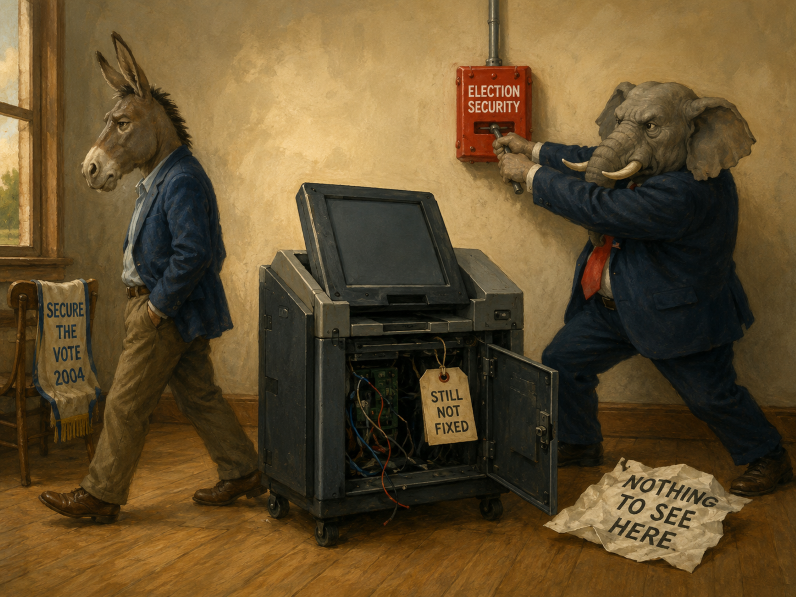
How Election Security Became a Republican Issue
Election security alarm has switched parties with every losing side. The vulnerabilities are real, exploitation is undemonstrated, and the SAVE Act fight shows both parties prefer the fight to the fix.
Category
10 critiques
Election security alarm has switched parties with every losing side. The vulnerabilities are real, exploitation is undemonstrated, and the SAVE Act fight shows both parties prefer the fight to the fix.

CNN frames a two-sided institutional fight as a one-directional "takeover." The funding law never named America250, the chair recommended the executive order, and the commission's own scandal history is absent.

Voters deserved a clear-eyed account of what California's mail ballot system is: its genuine procedural safeguards, its documented and actively litigated structural failures, and the significant gap between those two things. The fraud allegations around this specific race were largely weak, and the debunking was largely accurate. But the press's habit of treating a successful debunking as the end of the story — rather than the beginning of harder questions — meant that a federal guilty plea for voter registration fraud in Los Angeles County, nearly 900,000 uncleaned inactive voter registrations, and an ID standard that accepts gym memberships all went unreported in the week California's election system was under national scrutiny. The system may not be rigged. It is not, by any responsible reading of the available evidence, secure. Those are not the same statement, and journalism that treats them as interchangeable has failed its readers regardless of which direction it leans. Until politician fix this terrible system, California will continue to receive "rigged election" theories. Or maybe it is on purpose?

Jill Biden feared a stroke. Then she told the country he did a great job. CBS asked about the fear and not the praise. Her memoir says she flagged his health to doctors. CBS let her call it natural aging. Her husband's library has raised $4 million against a $200 million goal and his legacy is hemorrhaging donors. CBS promoted the book designed to address that without mentioning it. The publisher and CBS share a corporate parent. CBS did not disclose it. What CBS produced was a promotional piece. What the moment required was an interview. Those are two different things — and the gap between them is exactly what Rebuke Nation exists to name.

California doesn't have a commitment problem — it has an accountability problem. The state hosts over a quarter of the nation's homeless, two-thirds of them unsheltered, the majority mentally ill, and its own auditor can't evaluate whether 28 out of 30 programs work. "Advancing conversations" after years of this record isn't leadership — it's a talking point.
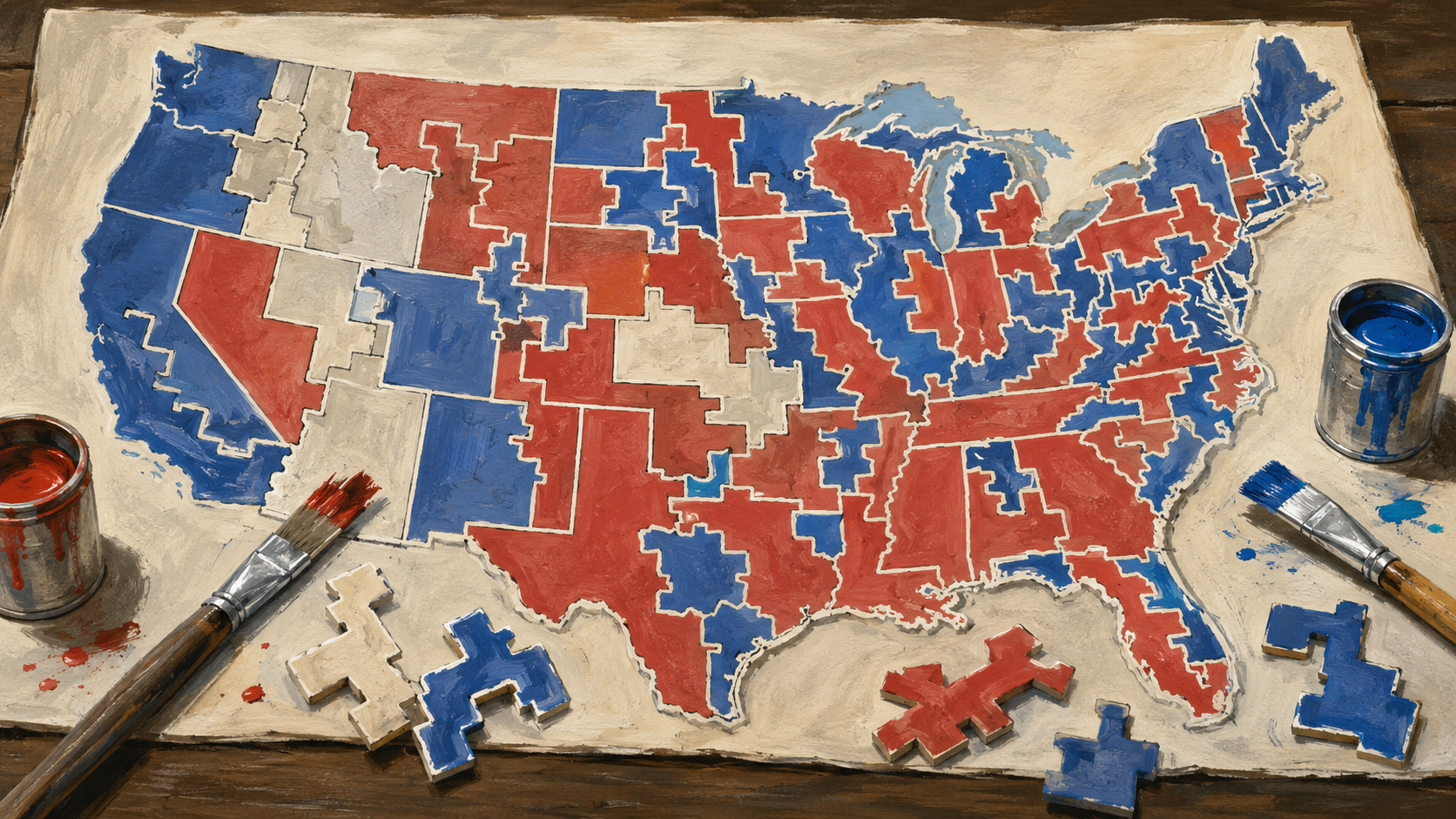
CNN's article accurately reports the facts of the current redistricting cycle but frames a decades-long bipartisan structural problem as a novel Republican power grab. The "+10 seats" headline obscures a pre-existing ~20 seat Republican structural advantage built long before this cycle began. Both parties are aggressively manipulating maps — and both parties have been doing so for decades, including in blue strongholds across the Northeast and Midwest. Readers deserve that full picture alongside the current cycle's scorecard.
Scott Bessent wrote "Resilience" on a notepad. A photographer captured it. HuffPost built a mockery piece around social media reaction while the same Cabinet meeting contained a president threatening to bomb allies, a DHS secretary saying a US senator deserved to be pepper-sprayed, and the president confusing Iran and Venezuela. The notepad story is not wrong. It is a distraction from the stories that mattered — and choosing it over them is an editorial decision HuffPost made without acknowledging it.
Pequeño argues Republican voters chose Paxton because they fear Trump's authoritarian grip. What she left out: Texas conservatives had been building grassroots opposition to Cornyn since his 2022 gun bill — years before Trump's endorsement; Cornyn voted FOR the SAVE Act in March 2026, undercutting the "principled moderate" framing; Paxton won by 26 points in a democratic election in which voters cited specific policy grievances, not fear; and the language of tyranny and authoritarianism applied to a democratic primary inverts the meaning of both words. Republican voters chose a candidate whose positions on guns and immigration aligned with theirs. That is not what tyranny looks like. It is what a primary looks like.

USA Today called Paxton's win a Republican loss. To sustain that verdict, the piece had to describe Cornyn as "a reliable conservative" while omitting the Uvalde gun bill that Texas conservatives found disqualifying; had to note Paxton's impeachment while burying his full acquittal in parentheses and omitting the DOJ's decision not to prosecute entirely; and had to imply Democratic electoral advantage while the most neutral polling shows a toss-up and Cook Political Report rates the seat lean Republican. Put those facts back in and the story changes: a conservative electorate rejected a bipartisan dealmaker who co-wrote a gun bill with Democrats, chose a candidate who was impeached by his own party and fully cleared, and produced a general election race that is competitive but still favors Republicans. That is a legitimate story. USA Today didn't tell it.

Axios got the facts right and the framing wrong. The individual events it describes are real and newsworthy. But bundling three unrelated stories into a single "the walls are closing in" narrative, treating a symbolic canceled House vote as structural presidential decline, and ignoring that Trump's primary endorsements delivered exactly what he wanted produces a conclusion the evidence does not support. The piece should have been labeled analysis or opinion. Filed as straight news reporting, it misleads readers not through fabrication but through the oldest trick in political journalism: letting the bottom line outrun the facts.
RSS Feed
Subscribe via RSS