
How Election Security Became a Republican Issue
By Don Keyhoetea · July 18, 2026 · 3 min read
Bottom Line
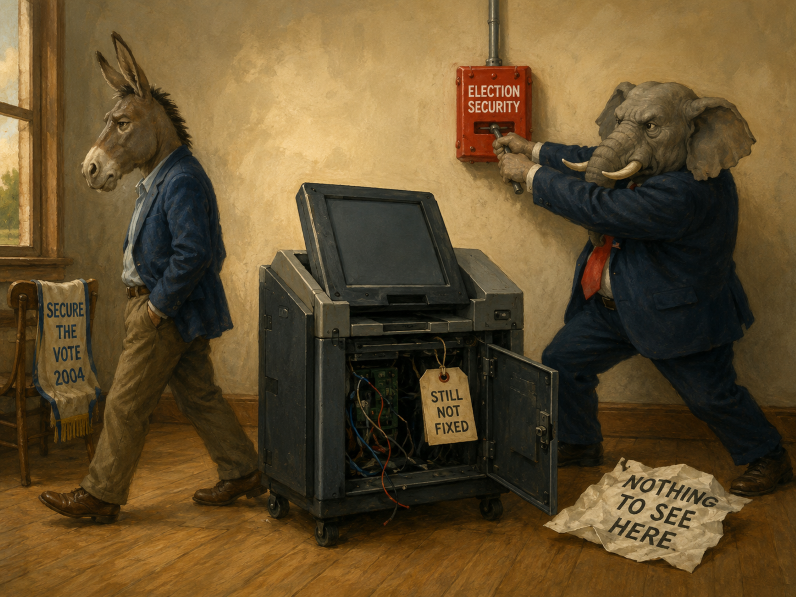
Election security alarm has switched parties with every losing side. The vulnerabilities are real, exploitation is undemonstrated, and the SAVE Act fight shows both parties prefer the fight to the fix.
Why It Matters
A bipartisan engineering problem is being treated as a loyalty test. Until that changes, the documented flaws in U.S. election infrastructure stay unfixed — available to whichever side tries first.
Background & Context
"Election security" is not one issue but four, and the parties have divided them between themselves. The term covers the machines that mark and count ballots, the registration systems that determine who may vote, the voter rolls that must be kept accurate, and the foreign actors who probe all of the above. Over the past two decades, Democrats have generally claimed the machine and foreign-interference concerns while Republicans have claimed the registration and roll concerns — with each party describing its own priorities as security and the other party's as a threat to democracy.
The current fight is at least twenty years old, and both parties have held both sides of it. In 2005, then-Senator Barack Obama introduced a resolution expressing the sense of Congress that voter identification requirements should be rejected. In 2006, a Republican-controlled House passed legislation sponsored by Representative Henry Hyde that would have phased in photo identification and documentary proof of citizenship — while requiring states to establish programs distributing IDs, in some cases at no cost. The bill never received a Senate vote. The same policy, the same objection, and largely the same coalitions now define the SAVE America Act debate in 2026, with one difference examined below.
The alarm about voting machines specifically began as a Democratic concern. In January 2005, Senator Barbara Boxer and Representative Stephanie Tubbs Jones formally objected to counting Ohio's electoral votes — the first objection joined by a senator since 1877 — citing machine misallocation, disproportionate lines in Democratic precincts, and a secretary of state who simultaneously co-chaired the state Bush campaign. Democrats that cycle circulated a fundraising letter from the chief executive of Diebold, then a major voting machine vendor, promising to help "deliver" Ohio's electoral votes to President Bush. Distrust of voting-machine vendors was a Democratic talking point sixteen years before any litigation over Dominion Voting Systems.
The Supreme Court settled the constitutional question about voter ID in 2008, but not the political one. In Crawford v. Marion County Election Board, the Court upheld Indiana's photo identification law in an opinion written by Justice John Paul Stevens, a member of the Court's liberal wing. Thirty-six states now require some form of identification to vote. The policy dispute since then has concerned how strict the requirements should be and who bears the cost of compliance — not whether identification requirements are permissible.
The Evidence
The Democratic security record runs from 2004 through 2019 and is substantive, not rhetorical. In 2016, a group of computer scientists led by University of Michigan professor J. Alex Halderman privately urged the Clinton campaign to seek recounts in Wisconsin, Michigan, and Pennsylvania, on the argument that electronic results could not be trusted without checking the paper record; the recount effort, ultimately funded by Jill Stein, found no fraud and slightly widened the Republican margin in Wisconsin. In 2018, Senator Kamala Harris told a Senate Judiciary Committee hearing that she had hosted a demonstration at the Capitol where researchers "before our eyes, hacked election machines." In 2019, House Democrats passed the SAFE Act, which would have mandated hand-marked paper ballots and risk-limiting audits — the reforms most security researchers recommend — and the Republican-controlled Senate declined to take it up.
The Republican security record centers on registration and rolls, and predates 2020. Beyond the 2006 Hyde bill and the post-Crawford wave of state identification laws, President Trump alleged after winning in 2016 that three to five million illegal votes had cost him the popular vote, and established a commission to substantiate the claim. The commission disbanded within a year without producing findings, after states governed by both parties refused its data requests. After the 2020 loss, the claims returned at greater scale, culminating in the current administration's July 16 declassification address and the legislative push examined below.
Documented election fraud in the United States is real, rare, prosecuted, and bipartisan. In 2007, two Cuyahoga County, Ohio election workers were convicted of felonies for rigging the 2004 presidential recount sample — pre-screening ballots so the mandatory hand count would match machine totals, corrupting the verification process itself. A Philadelphia judge of elections, Domenick DeMuro, pleaded guilty in federal court to adding fraudulent votes on the machines for Democratic candidates in exchange for cash across elections from 2014 to 2018; the consultant who paid him, former Representative Michael Myers, was convicted of the bribery. North Carolina's Ninth District congressional election was voided in 2018 — the only modern congressional election overturned for fraud — after a Republican operative ran an illegal absentee ballot collection operation; the state's bipartisan elections board refused certification unanimously and ordered a new election. In 2020, a Hawthorne, California mayoral candidate was prosecuted after submitting more than 8,000 fraudulent voter registrations, a scheme detected by automated volume flags before any fraudulent vote was cast.
The machine-vulnerability record is equally settled, in both of its parts. The Cybersecurity and Infrastructure Security Agency confirmed nine exploitable vulnerabilities in widely deployed Dominion ImageCast X ballot-marking devices in a June 2022 advisory. Court-supervised research in Georgia federal litigation demonstrated the flaws could be exploited by an attacker with access. The DEF CON Voting Village has compromised nearly every voting machine placed before its researchers since 2017. At the same time, no audit, court proceeding, or investigation has found these vulnerabilities exploited to alter an election outcome — including an investigation of more than 10,000 investigator hours commissioned by Arizona's Republican attorney general, whose exculpatory internal findings were withheld from the public until his successor released them in 2023.
Post-2020 conduct by both parties diverges from both parties' stated alarm. The administration describing election infrastructure as "an unprecedented election security nightmare" reduced CISA's election security mission — the federal program assisting state officials against foreign intrusion — a contradiction election officials raised publicly within hours of the July 16 address. Republican-led states withdrew from ERIC, the interstate consortium that identifies duplicate registrations, deceased voters, and ineligible registrants, during 2022 and 2023 after the compact became the subject of conspiracy claims — removing themselves from the primary functioning tool for the roll accuracy Republicans demand. On the Democratic side, the party's response to the July 16 election security address consisted of Senator Schumer's statement that the accompanying legislation would pass "Not now. Not ever," and Senator Markey's call for impeachment — a refusal and an escalation, with no competing security proposal attached.
The SAVE America Act is the current test case, and its legislative facts are as follows. The bill requires documentary proof of citizenship — a valid U.S. passport, a REAL ID-compliant document indicating citizenship, or specified document combinations — to register to vote in federal elections; requires photo identification to cast a ballot; and requires states to remove noncitizens from existing rolls. Its narrower predecessor, the SAVE Act, passed the House 220-208 in April 2025. The expanded version passed the House 218-213 in February 2026, with 217 Republicans and one Democrat in favor, and stalled in the Senate in March, where Republicans lack the sixty votes to overcome a filibuster. The July 16 presidential address functioned in substantial part as a campaign to revive it.
The evidence on the bill's effects cuts in both directions. Supporting the bill: federal registration currently verifies citizenship by self-attestation — a checkbox signed under penalty of perjury — and the 2018 California DMV automatic-registration failure, which generated erroneous registrations for ineligible residents, six of whom voted before detection, demonstrates that system errors pass through that honor system. A new Department of Homeland Security review claims approximately 278,000 noncitizen registrations across several states; the methodology awaits scrutiny, but registration-list integrity is a legitimate object of policy regardless. Against the bill: the Bipartisan Policy Center estimates roughly twelve percent of registered voters lack ready access to the required documents, with access skewing by income and education; the in-person documentary requirement would effectively end most online and mail registration as currently practiced; the bill criminalizes election officials who register an applicant without documentary proof even when the applicant is in fact a citizen, and authorizes private lawsuits against those officials, a combination the Bipartisan Policy Center warns will push a depleted election workforce toward defensive refusal; and its identification rules exceed those of most of the thirty-six states that already require ID. The 2026 bill contains no funded document-issuance program — the provision that distinguished the 2006 Republican version.
The Analysis
What changed after 2020 was not the underlying facts but the cost of discussing them. The vulnerability findings, the fraud base rate, and the foreign collection pattern were all documented before 2020 and have not materially changed since. What changed is that machine vulnerability became the central premise of an effort to overturn a presidential result, which converted a technical subject into a partisan identifier. After that conversion, a Democrat stating the CISA-confirmed fact that voting equipment contains exploitable flaws risked being heard as endorsing the stolen-election claim — even though the researchers who documented the flaws reject that claim explicitly and consistently. The topic was not won by one party; it was abandoned by the other. The researchers themselves have described the effect: their findings are now dismissed or embraced based on who cites them rather than what they show.
Each party's preferred security measures map onto its electoral coalition, which explains the sorting better than sincerity or conspiracy. Paper trails, audits, and machine regulation impose costs on vendors and administrators but not on voters, and Democrats support them. Documentary proof and polling-place identification impose compliance costs concentrated among lower-income, younger, and more transient voters, and Republicans support them. Each party labels its own list "security" and the other's list "suppression" or "denialism." The mapping is too clean to be coincidence and too stable across twenty years to be about any single election.
The most probative evidence is the compromise that has never been offered. Nothing prevents pairing documentary proof of citizenship with free, automatic document issuance and a records-matching alternative — verifying citizenship against federal data the government already holds, so that eligibility is confirmed without requiring a certified birth certificate from a courthouse three states away. The template has existed since the 2006 Hyde bill, which coupled identification requirements with state-funded ID distribution. Nothing prevents Republicans from restoring CISA's election mission and rejoining ERIC as demonstrations that the security concern is operational rather than rhetorical. Nothing prevents Democrats from answering the SAVE America Act with a counteroffer trading verification for free issuance. Twenty years of Congresses controlled at various times by each party have produced none of these. The narrowest inference the record supports is that the dispute is more valuable to both parties than its resolution.
The inference the record does not support is complicity. The proposition that one party resists security measures because it benefits from insecurity would require evidence of exploitation, and none exists after audits, prosecutions, and investigations conducted by officials of both parties — including Republican officials with every incentive to find it. It would also have to account for Democrats mandating, in the 2019 SAFE Act, precisely the paper-and-audit regime that would detect machine manipulation, and for the fraud prosecutions that have landed on both parties roughly as often as each party's operatives have attempted fraud. The same logic applied in the opposite direction — that Republicans support identification requirements because they benefit from reduced turnout — carries the identical evidentiary gap and is asserted with identical confidence by the other side. Both inferences substitute motive for mechanism.
Counterpoints
The strongest objection to this analysis is that the post-2020 asymmetry is justified rather than symmetrical. On this view, the parties' positions are not mirror images: one party's 2020 activity included fraudulent elector certificates in seven states, resulting in indictments, and pressure on state officials to alter certified results — conduct with no Democratic equivalent in 2004 or 2016, when objections ended at floor speeches and funded recounts. The documented record supports that distinction, and this publication has drawn it. The distinction does not, however, resolve the machines. Vulnerabilities confirmed by the government's own cybersecurity agency do not become less real because the people currently citing them include people who misused the subject, and a security posture organized around refusing an opponent's framing is not a security posture.
A second objection holds that the SAVE America Act's burdens are overstated because most Americans possess the required documents. This is partially supported: most registered voters do have access to a passport, a citizenship-indicating REAL ID, or a birth certificate. The twelve percent who lack ready access, per the Bipartisan Policy Center, still represent tens of millions of registrants, concentrated demographically in ways both parties understand; and the bill's official-liability provisions create compliance risk independent of any voter's documentation. The burden argument is not a reason to reject citizenship verification categorically. It is a reason the absence of a free-issuance provision is the bill's most informative feature.
A third objection holds that noncitizen registration numbers vindicate the bill's urgency. The DHS figure of approximately 278,000 registrations, if it survives methodological scrutiny, would demonstrate a registration-integrity gap worth closing. Registration is not voting, and every audit that has traced registrations to ballots — including Georgia's multi-decade review — has found actual noncitizen voting vanishingly rare, typically detected, and prosecuted. The evidence supports fixing the front door. It does not support the claim that outcomes have turned on who came through it.
Media Coverage / Public Narrative
Conclusion
Sources
- 1. CRS In Focus IF12902 — SAVE America Act and Federal Voter Registration Policy
- 2. Bipartisan Policy Center — "Six Things to Know About the SAVE America Act"
- 3. SAVE America Act House-passed text (S. 1383 as amended)
- 4. Ballotpedia News — Senate takes up the SAVE America Act
- 5. CNBC — SAVE America Act overview
About the Author
Don Keyhoetea
Don Keyhoetea writes for Rebuke Nation, an independent publication focused on media analysis, political framing, and source-based accountability.
Never miss a critique.
Subscribe to our RSS feed and get every new fact-check and media analysis delivered directly to your reader — no algorithm, no noise.