
Your Dollar Isn't Coming Back — And Nobody in Power Will Say It
By Don Keyhoetea · June 11, 2026 · 22 min read
Bottom Line
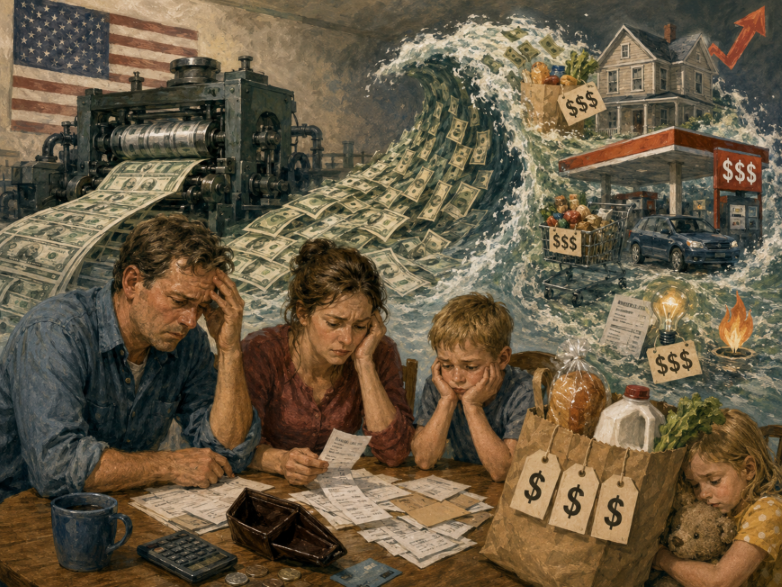
Since 2020, cumulative inflation has erased nearly 23% of the dollar's purchasing power — and that ground is not coming back. The mechanism was straightforward: six COVID-era relief laws pumped $4.6 trillion into the economy, the Federal Reserve expanded the money supply by 42% in 22 months, and the warnings from economists like Larry Summers were dismissed in real time as politically inconvenient. Both parties voted for the spending. Both administrations signed the bills. Neither has offered the public an honest account of the permanent cost. The Federal Reserve, far from being a neutral backstop, spent two decades cutting rates to successively lower floors after every crisis, institutionalizing a preference for cheap money and a formal 2% annual erosion of purchasing power that has been marketed as "stability." And the gold standard — for all its real limitations — kept average inflation near zero for over a century before it was abandoned, a track record the fiat era has never approached. Meanwhile, the current administration is imposing tariffs that economists broadly describe as inflationary while pressuring the Fed toward looser monetary policy — the combination most likely to revive the conditions of 2021. What Americans deserved across all of this was a political and media class willing to explain the cause clearly, acknowledge the loss honestly, and make the case for the fiscal discipline that is the only legitimate path forward. What they got was a rotating cast of scapegoats, a campaign promise that was either dishonest or economically illiterate, and a central bank that has never fully reckoned with its own role in the problem it is asked to solve.
Background & Context
The Analysis
There is a version of the inflation story that gets told in press briefings, cable news panels, and congressional hearings. It involves supply chains. It involves Vladimir Putin. It involves corporate greed and price gouging. Depending on the political party doing the telling, it involves either the previous administration or a temporary disruption that is now mostly under control. What it almost never involves is an honest account of the mechanism — the actual cause-and-effect chain that runs from government decisions to the price of eggs.
So let's start there.
Inflation is not prices going up. That is the symptom. Inflation is your dollar losing value. When the government — through the Federal Reserve, through congressional spending, or through some combination of both — increases the number of dollars circulating in the economy faster than the economy produces goods and services, each individual dollar buys less. More money chasing the same amount of stuff means sellers can charge more for each unit of stuff. This is not ideology. This is not partisan talking points. This is the foundational principle of monetary economics, documented for centuries, that virtually every serious economist across the ideological spectrum accepts as true.
M2, the broad measure of the U.S. money supply that includes currency, bank deposits, and money market funds, grew at a 26.9% rate year-over-year in February 2021 — a figure that easily exceeded the money growth rates of both the inflationary 1970s and 1980s, and every quantitative easing program run after the 2008 financial crisis. In total, the Fed drove a $6.4 trillion increase in M2 between March 2020 and the end of 2021 — a 42% increase in just 22 months, far more than could be absorbed by economic growth even with the strong recovery that followed.
To put that in plain terms: the United States pumped nearly half again as much money into the economy in less than two years as had existed before. Nothing like it had happened in the modern era.
This money came from several converging sources simultaneously. Six COVID-19 relief laws enacted in 2020 and 2021 provided approximately $4.6 trillion in funding for pandemic response and recovery. Of those funds, approximately $1.8 trillion went directly to individuals and families — $844 billion in stimulus check payments and $666 billion in enhanced unemployment compensation. Businesses received approximately $1.7 trillion more, much of it through the $835 billion Paycheck Protection Program. Three rounds of direct stimulus checks hit American bank accounts: $1,200 per filer in March 2020 under the CARES Act, $600 per filer in December 2020, and $1,400 per filer in March 2021 under the American Rescue Plan.
Alongside the direct spending, the Federal Reserve was simultaneously buying trillions of dollars of Treasury bonds and mortgage-backed securities to keep credit markets liquid and interest rates near zero. The combined effect of the Fed creating new reserves and the Treasury putting money directly into public deposits resulted in the historic spike in U.S. money supply measures.
In fiscal year 2020 alone, government spending surged 47.3% to $6.55 trillion, while revenue fell to $3.42 trillion, producing a deficit of $3.1 trillion — more than double the previous record set in 2009 during the financial crisis, and the highest deficit as a share of GDP since 1945, when the U.S. was borrowing to fight World War II.
Not everyone was caught off guard. Larry Summers, former Treasury Secretary under Clinton, warned in early 2021 that the $1.9 trillion American Rescue Plan would create excess demand and cause the economy to overheat. Biden administration officials dismissed his warning, arguing inflation would merely be "transitory." Instead, inflation soared — reaching a four-decade high of 9.1% in June 2022. Summers had cautioned that the scale of fiscal and monetary stimulus could unleash inflation "of a kind we have not seen in a generation." Democrats in Washington brushed him off, dismissing fears about "running the economy hot." Sixteen months later, inflation hit its highest level since 1981. Food prices shot up 21% in three years, and borrowing costs for homes, cars, and credit cards climbed sharply.
This is not ancient history. It is the direct cause of the affordability squeeze that is driving American political anxiety right now. But to understand why it happened so fast — and why it was so predictable — you have to go back further. Because America had been here before. And learned nothing from it.
The Last Time America Did This
The inflation of the 2020s did not emerge from a vacuum. It emerged from a system already weakened by decades of fiscal recklessness — and whose underlying vulnerability traces to a decision made more than fifty years ago.
The story begins in the late 1960s, when the federal government tried to simultaneously fund the Vietnam War and Lyndon Johnson's Great Society domestic programs — a fiscal combination economists called "guns and butter." That sustained spending created budget deficits that fueled inflation, and with more dollars in circulation than could be backed by the nation's gold reserves, the U.S. had effectively printed more money than it could honor.
Inflation, which had averaged around 1% from 1952 to 1964, began rising in 1965, hit nearly 5% by 1968, and reached 6.5% by 1970. Foreign governments, watching the dollar lose value, began redeeming their dollar holdings for gold as they were entitled to do under the Bretton Woods agreement. By 1971 the situation was unsustainable.
On the evening of August 15, 1971, President Nixon addressed the nation and closed the gold window — foreign governments could no longer exchange their dollars for gold. In effect, the international monetary system became a fiat one. Nixon reportedly told his Fed chairman: "We can take inflation if necessary, but we can't take unemployment" — and pressured the Fed to keep rates low heading into the 1972 election. The last hard institutional brake on money creation had been removed.
The Arab oil embargo of 1973 is widely blamed for the 1970s inflation, but the embargo did not even start until inflation was already running at 8%. Oil certainly worsened things — prices surged 400% — but inflation was already a structural problem before a single barrel was withheld
By 1979 the crisis was undeniable. When Paul Volcker took office as Fed chairman in August of that year, year-over-year inflation was running above 11%, and the prevailing professional view among leading economists was that Americans should regard the problem of inflation as essentially intractable.
Volcker chose to treat it as tractable, but the medicine was brutal. The Fed funds rate was raised to an all-time peak of 20% by June 1981. The prime rate reached 21.5%. Mortgage rates soared above 18%. A family buying a home with a $100,000 mortgage at 18% faced monthly payments nearly double what they would have paid just a few years earlier. Home sales collapsed. Auto sales collapsed. Business investment collapsed.
What followed was the worst economic downturn in the United States since the Great Depression. Unemployment rose to 10.8% in 1982. There were thousands of business bankruptcies. Volcker received death threats. Congressional pressure was immense, with members from both parties introducing legislation to strip the Fed of its independence or force rate cuts.
He ignored all of it. By October 1982, inflation had fallen to 5%, unemployment began a steady decline, and the economy entered a new period of sustained growth and low inflation.
The Volcker episode is the only modern example of a government actually defeating serious inflation after allowing it to take hold. And what it teaches is not reassuring: the cure required causing one of the worst peacetime recessions in American history, sustained deliberately, for years, against ferocious political opposition. Ronald Reagan, to his considerable credit, stood by Volcker through the pain despite the political damage. No elected government since has been willing to impose that kind of medicine. The temptation — always — is to declare victory early, ease off, and let the next administration inherit the consequences.
Why "Inflation Is Down" Is Not the Whole Story
When a politician or a news anchor says inflation has "come down" from its 2022 peak, they are telling you something technically accurate and practically incomplete. The rate of price increases has slowed. Prices themselves have not reversed.
According to Bureau of Labor Statistics data, a dollar in 2020 is worth the equivalent of about $1.29 today — meaning prices have risen by roughly 29% cumulatively since the COVID spending began. A dollar today only buys about 77 cents of what it could buy in 2020. That purchasing power is not coming back. It does not return when the inflation rate hits 2%. The rate measuring the pace of price increases is separate from the price level itself. Slowing the rate means prices are rising more slowly — not that they went back down.
Think about what that means concretely. A family paying $1,200 per month for an apartment in early 2020 that now pays $1,600 for the same unit is not made whole by news that the rental inflation rate has eased to 3% annually. Their monthly housing cost went up $400 — permanently. Their wages, in most cases, did not keep pace. Their savings, if they had any, lost nearly a quarter of their real value. And they are being told the problem has been largely solved.
The only mechanism that would actually restore prior price levels — deflation — would require removing trillions of dollars from circulation. The way you do that is through prolonged high interest rates and contraction of the money supply, which historically produces recessions, surging unemployment, and waves of business failures. No elected government in American history has voluntarily imposed that on its population when the alternative was to simply declare that the current higher prices are the new normal. They always choose the new normal. Which means the loss is permanent.
The Political Cover Stories
The maddening part of this story is not that a crisis happened. Crises happen. The maddening part is the sustained dishonesty about what caused it — and the continuation of the same underlying behaviors on both sides of the aisle.
The Biden administration's initial line was that inflation was "transitory." Summers had infuriated his own party by predicting in early 2021 that the American Rescue Plan would overheat the economy, and then by rejecting the Fed's insistence that inflation would be transitory. He was right on both counts, and was dismissed until the data made further dismissal impossible.
Once the "transitory" line collapsed under a 9.1% headline number, the explanation shifted to supply chains, then to Putin's invasion of Ukraine, then to "corporate greedflation." There is a sliver of truth in the corporate margin argument — some companies did use the inflationary environment to raise prices beyond their cost increases. But it does not explain why inflation was broad-based across virtually every sector simultaneously. Simultaneous spikes in rent, food, vehicles, utilities, insurance, and childcare are not caused by a handful of executives deciding to get greedy in the same quarter. A flood of new money is.
Meanwhile, the Republican Party spent the Biden years correctly criticizing the spending while conveniently omitting that the first massive spending bill — the $2.2 trillion CARES Act — was signed by Donald Trump and passed with Republican votes in March 2020, followed by a $900 billion follow-up Trump signed in December 2020. The bipartisan fingerprints are too numerous to assign blame selectively, but that has not stopped either party from trying.
Now, in his second term, Trump has taken a posture that should alarm anyone who lived through 2021 and 2022. Trump has imposed massive import tariffs that are overtly inflationary — making thousands of everyday products more expensive — and is simultaneously trying to pressure the Federal Reserve into adopting a looser monetary policy. When asked about automakers potentially raising prices in response to his tariffs, he responded: "I couldn't care less if they raise prices. I hope they raise their prices." That may reflect a coherent view that tariff revenue and manufacturing goals outweigh consumer price concerns. It is not consistent with the campaign promise to end inflation. And it reflects the same political instinct that has driven inflationary policy for half a century: prioritize the short-term political goal, defer the cost to the public.
The Federal Reserve: Not the Solution to the Problem It Helped Create
When inflation spiraled in 2022, the Federal Reserve was cast as the responsible adult — the institution that would raise rates and restore order. The Fed did raise rates, aggressively, and inflation did come down from its peak. But treating the Fed as a neutral referee that simply responds to inflationary crises misreads its history. The Fed has not only failed to prevent inflation cycles — in several critical instances, it actively set them in motion.
The 2% inflation target the Fed officially adopted in 2012 is the place to start. By the Fed's own advisors' admission, the target is relatively arbitrary. It did not emerge from rigorous research or democratic deliberation — it originated from an offhand comment by a New Zealand central banker in 1988 and spread to other central banks over the following decades. What this target means in practice is that the Federal Reserve is not trying to maintain the value of your dollar. It is managing a controlled, permanent devaluation of your dollar — aiming for roughly 2% less purchasing power every year, indefinitely. An annual inflation rate of 2% is considered "healthy" in modern fiat-backed economies — but at 2% compounded annually, the purchasing power of a dollar erodes by roughly 18% over a decade. The permanent, predictable debasement of the currency has simply been normalized.
The Fed's defenders argue that mild inflation is preferable to deflation, which can trigger economic contraction. That argument has real merit in narrow circumstances. But it papers over a troubling institutional reality: the Fed has a structural preference for loose money, and its track record on tightening when it should — early enough, hard enough — is poor.
Following the 2001 recession, Fed chairman Alan Greenspan slashed the federal funds rate from 6.25% to 1.75%, reduced it further through 2002 and 2003, and held it at a record low of 1% through mid-2004. This created excessive liquidity and generated a massive demand bubble in housing. Greenspan himself encouraged individuals to take adjustable-rate mortgages rather than traditional fixed-rate mortgages during this period. The share of new mortgages with adjustable rates more than doubled between 2001 and 2004. When rates eventually rose, millions of those borrowers could not make their payments. The 2008 financial crisis — and the $700 billion TARP bailout, the subsequent decade of near-zero interest rates, and the trillions in quantitative easing that followed — traces directly back to a Fed that kept rates too low, too long, to avoid short-term pain.
After each economic disruption from 1982 through 2020, the Fed took rates to a new lower low. After the tech crash of 2000 and the 9/11 attacks, it cut to 1%. After the Great Recession of 2008, it pushed rates to near zero for nearly a decade — then pushed them back to near zero again during COVID. This pattern is not coincidence. It reflects an institutional bias toward cheap money, justified each time as an emergency response to the previous crisis, while planting the seeds for the next one. The COVID-era repeat — zero rates from March 2020 through March 2022, while overseeing a $6.4 trillion expansion of the money supply — was not a surprise to anyone who had watched the Fed's behavior for the previous two decades. The institution nominally responsible for preventing monetary excess was the instrument of it.
What the Gold Standard Got Right — And Why It Matters Now
The abandonment of the gold standard is treated in most mainstream economic commentary as a settled question — a relic of the past that serious people have moved beyond. That framing deserves more scrutiny than it typically receives.
Inflation averaged only 0.2% per year from 1790 to 1913 — the year the Federal Reserve was created. Under the Fed-managed gold standard that followed, it averaged 2.7% from 1914 to 1971. Since the dollar was fully severed from gold in 1971, it has been higher still. That is a century and a half of evidence that tying currency to a fixed commodity constraint produces a fundamentally more stable store of value than giving a committee of economists discretion over the money supply.
A study covering many countries found that every country in the sample experienced a higher rate of inflation during the period in which it operated under a fiat standard than the period in which it operated under a commodity standard. A separate study of approximately 30 currencies found there has not been a single case of a currency freely manipulated by its government or central bank since 1700 that enjoyed price stability for at least 30 consecutive years.
The logic behind why gold worked is not complicated. Under a gold standard, the government could not simply create more money. Every dollar in circulation was backed by a corresponding amount of gold in the Treasury. If the government wanted to spend beyond its tax revenue, it had to borrow from willing lenders at market rates — it could not quietly dilute the currency to finance the gap. Competition among gold miners adjusted the money supply in response to changes in demand, making purchasing power stable and predictable over long periods. The threat of customers redeeming notes and deposits for gold discouraged banks from overissuing. These were automatic constraints — not dependent on the wisdom or political independence of any appointed committee.
The limitations of the gold standard are real and should not be glossed over. A fixed gold supply can constrain economic growth during periods of rapid expansion. Countries hit by sudden gold outflows through trade deficits or financial panics could face sharp monetary contractions with little recourse. The system offered less flexibility during genuine emergencies. A gold standard can also be undermined simply by a government changing the official gold-to-money ratio — as Roosevelt did in 1933 when he effectively devalued the dollar against gold, and as Nixon completed in 1971 when he severed the link entirely. A sufficiently determined political class can escape any monetary constraint. History proves it.
But "the gold standard has limitations" is a different argument from "unlimited government control of the money supply works well in practice." The post-1971 evidence for the latter does not exist. Fiat dollars are not constrained by the supply of gold or any other commodity. The Federal Reserve can expand the money supply as much or as little as it sees fit. When the Fed expands it too much, an unsustainable boom and costly inflation follow. We know this because we have watched it happen — in the 1970s, in the housing bubble of the 2000s, and again in the 2020s. The question is not whether the gold standard was perfect. It was not. The question is whether a system of institutionalized discretion — controlled by a committee with a structural preference for loose money, subject to political pressure campaigns, and formally committed to a 2% annual erosion of your purchasing power — is genuinely better. The post-1971 record makes that case harder to defend than mainstream commentary admits.
What the gold standard conversation points to is a deeper principle: money needs to be constrained by something a government cannot simply decide to override when it becomes inconvenient. Gold was one such constraint. It had flaws. But the alternative — no constraint at all beyond the good intentions of the institution doing the printing — has now produced the most severe peacetime inflation in American history within living memory. That is not a legacy worth defending in the name of monetary modernity.
What an Honest Fix Actually Looks Like
Real solutions to inflation exist. They are not glamorous, they do not fit on bumper stickers, and they require politicians to tell voters things the voters do not want to hear.
The first requirement is stopping structural deficit spending. Federal deficits increased steadily from the 1960s through the early 1990s, declined through the late 1990s, rose sharply after 2001 and again through the 2008 crisis, and then exploded during COVID — reaching $3.13 trillion in 2020. The fiscal year 2025 deficit came in at $1.77 trillion, and projections show deficits of $2 trillion or more extending through the decade. The U.S. government is spending roughly $1.50 for every $1.00 it takes in. Every dollar of that gap is either borrowed — adding to a national debt that has grown to an estimated 132.8% of GDP — or monetized through Federal Reserve bond purchases, which expands the money supply. Cutting spending is painful. Raising taxes is unpopular. Doing neither and running trillion-dollar deficits indefinitely is a tax on the purchasing power of every American, paid slowly and invisibly through the declining value of their money.
The second requirement is supply-side expansion — growing the actual productive capacity of the economy so that more goods and services are chasing the dollars already in circulation. Domestic energy production, housing construction reform, reducing regulatory barriers to manufacturing — these are genuinely anti-inflationary policies because they increase supply rather than just restricting demand. Tariffs work in the opposite direction: they raise the cost of imported goods across the board, which is inflationary regardless of their strategic rationale.
Third — and this one is rarely discussed — Americans need a broader culture of financial literacy. Understanding money supply, the difference between the rate of inflation and the price level, and why the Fed's institutional preferences have historically favored debasement over stability is not optional knowledge for a self-governing republic. An electorate that does not understand what causes inflation cannot hold its representatives accountable for creating it.
The Political Danger Nobody Is Talking About
There is a broader warning embedded in this story that the affordability conversation in American media almost never addresses.
When ordinary working people — who played by the rules, worked steadily, and saved responsibly — find that their purchasing power has permanently declined, that their wages do not keep up with rent, that their savings account lost a quarter of its real value in five years, and that the people responsible are changing the subject rather than acknowledging the cause, they do not simply shrug and vote for the other party. They start looking for explanations that feel satisfying. And the explanations that feel most satisfying are not always the ones that are most accurate.
Socialism, government price controls, and expanded dependency programs are gaining ground in American political culture right now — not because the underlying economic arguments for them have gotten stronger, but because the mainstream political system has failed to explain what actually went wrong. When people cannot understand why working hard no longer seems to be enough, and no credible voice offers them the honest explanation, they reach for the one that assigns blame to a legible villain: corporations, the wealthy, the system. From there, the policy prescriptions follow predictably — price controls, wealth taxes, guaranteed income, nationalized industries.
History is unambiguous on what these produce. Price controls, tried by Nixon himself in 1971 as part of his economic policy response, created shortages within months. Every government that has attempted to administratively set prices below market-clearing levels has produced the same outcome: goods disappear from shelves, move to black markets, or degrade in quality. Expanded entitlement programs, once established, are nearly impossible to dismantle politically — and they are funded by more government spending, more borrowing, more money creation. The cycle feeds itself.
The conservative and free-market voices in American public life who understand why this is true have an obligation they are mostly failing to meet. Criticizing socialist proposals is not enough. Winning that argument requires offering Americans a credible alternative explanation for their economic pain — one that is historically grounded, factually honest about who made the decisions and when, and serious about the discipline required to address it. Gesturing at the other party while running your own trillion-dollar deficits is not a serious alternative. It is the same problem with a different face.
The affordability crisis is real. The anger is justified. The question is whether the democratic institutions of this country can produce leaders willing to explain the truth clearly enough, and persuasively enough, that the public chooses disciplined solutions over satisfying ones. That question does not yet have a clear answer.
Sources
- 1. Federal Reserve Bank of St. Louis — The Rise and Fall of M2
- 2. American Farm Bureau Federation — Inflation and Money
- 3. U.S. GAO — COVID-19 Relief Funding and Spending as of Jan. 31, 2023
- 4. Anti-Fraud Coalition — COVID-19 Relief Funds Two Years Later
- 5. U.S. Government Spending — Deficit and Debt History
- 6. CNN — Larry Summers Sends Inflation Warning to White House (May 2021)
- 7. Federal Reserve History — The Great Inflation
- 8. Federal Reserve History — Nixon Ends Convertibility of U.S. Dollars to Gold
- 9. AOL Finance — Commentary: Trump Never Cared About Inflation
- 10. Benzinga — After Each Economic Disruption from 1982–2020, the Fed Took Rates to a New Low
- 11. Freedom and Prosperity — A Gold Standard vs. the Federal Reserve's Fiat Money
About the Author
Don Keyhoetea
Don Keyhoetea writes for Rebuke Nation, an independent publication focused on media analysis, political framing, and source-based accountability.
Never miss a critique.
Subscribe to our RSS feed and get every new fact-check and media analysis delivered directly to your reader — no algorithm, no noise.