
Who Is Actually Investigating the Houston ICE Shooting? Not Who ABC Implies
By Don Keyhoetea · July 9, 2026 · 8 min read
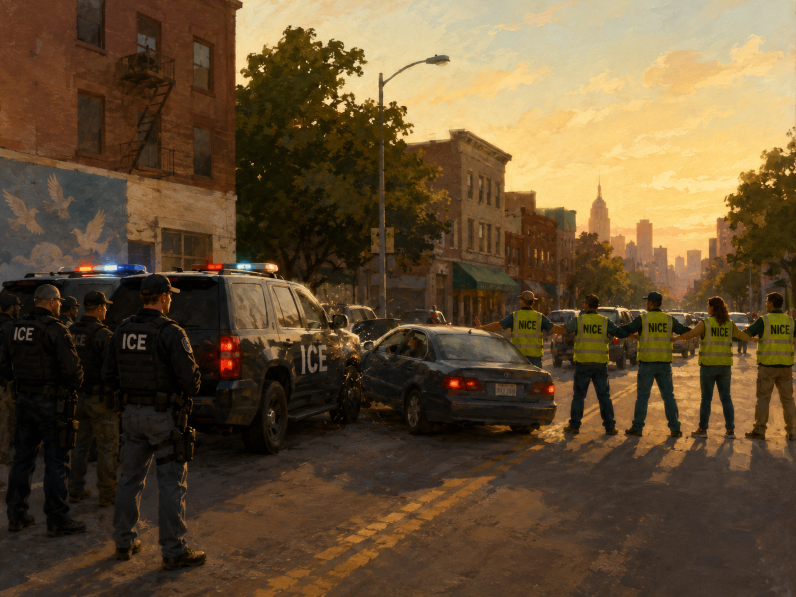
'He did not deserve to die,' son of man fatally shot by ICE officer in Houston says
The Quick Rebuke
ABC'S COVERAGE
Needs ContextABC accurately reports the family's grief and ICE's claims but omits the fact neither side disputes — the van did not stop — and the investigative and use-of-force context readers need to weigh either account.
Why It Matters
Without the flight, DHS's vehicle-fire policy, or who leads each probe, readers cannot evaluate the shooting at all — they can only choose between a grieving family and an agency statement.
ABC's Main Claim
What Needs Context
Both accounts agree the van did not stop, and the article never says so. This is the load-bearing fact of the encounter and it is common ground. ICE says Salgado Araujo fled a targeted vehicle stop. His family does not claim he pulled over and was shot anyway — their account, given by his son, is that he drove fast because unmarked cars were following him and he feared his tools would be stolen, and that he would have stopped had he seen a law enforcement emblem. The dispute is over why he fled and whether the officer's response was lawful, not whether he fled. A reader can finish ABC's article without learning the single fact neither side contests.
"The FBI is now investigating the situation" understates who controls the shooting probe. Per the FBI's Houston field office, the Department of Homeland Security's Office of Inspector General leads the investigation into the shooting itself, while the FBI leads a separate investigation into the potential assault on a federal officer — meaning the FBI's active case concerns the man who was shot, and the shooting is being reviewed by the same department whose officer fired. That structure is the entire basis for the independent-investigation demand ABC is reporting on, and the article's one-sentence description obscures it.
The use-of-force framework that decides this case is absent in both directions. DHS's own policy prohibits officers from firing at the operator of a moving vehicle unless necessary to stop a serious threat, and unlike many police agencies' best practices, its rules do not explicitly instruct officers to move out of a vehicle's path. That restriction cuts against the officer. Cutting the other way: under Tennessee v. Garner and Graham v. Connor, deadly force is judged by whether the officer reasonably perceived an imminent threat of death or serious injury to himself or others — and ramming an occupied law enforcement vehicle can constitute that threat without any officer standing in the vehicle's path, a principle the Supreme Court applied to fleeing drivers in Scott v. Harris and Plumhoff v. Rickard. Neither the policy that could fault the officer nor the doctrine that could justify him appears anywhere in the article.
This framework is available to newsrooms — it was deployed in force five months ago. After ICE officer Jonathan Ross shot Renee Good in Minneapolis in January, the Associated Press published a dedicated explainer on the rules for firing at moving vehicles within a day, and outlets from Fortune to WBUR to The Trace ran policing experts and law professors through the standards in detail. The framework appears when video indicts an officer and disappears when the evidence is unresolved. Houston is unresolved, and the framework is gone.
The available video establishes the stop, not the shooting. Business surveillance footage obtained by KHOU and FOX 26 shows the van pursued by dark SUVs that appear unmarked, a U-turn, and the vehicles stopping alongside a business. It does not show the alleged ramming, the alleged attempt to run over an officer, or the moment of the shooting, and it does not show whether lights or sirens were used. Bystander video captures only the aftermath. The decisive evidence — body camera footage, dash camera footage, the officer's identity — remains unreleased, and the three passengers who witnessed the shooting were detained by ICE and, per the family, have been unreachable since.
The record on prior DHS accounts runs in both directions, and ABC invokes neither. In Franklin Park, Illinois, DHS said an agent was hospitalized with serious injuries after being dragged by Silverio Villegas González's car; local police video showed the agent walking around calling his injuries minor. In Minneapolis, video contradicted the threat framing around Renee Good. In Patterson, California, ICE's claim that a man it shot was wanted for murder in El Salvador was undercut by court records showing a 2019 acquittal, records ICE has not answered for. DHS revised its account of a December shooting in Glen Burnie, Maryland after local police contradicted it, and federal judges dismissed prosecutions arising from two other vehicle shootings — one with prejudice for prosecutorial misconduct, one after bodycam footage suggested the agent drove into the defendant's truck. At the same time, the Harrisburg suspect ICE fired at six days before Houston had a documented record including assault and hit-and-run and fled into a civilian vehicle. The honest pattern is double-sided: the people involved almost uniformly fled, and the government's threat characterizations have repeatedly failed independent scrutiny. Coverage that drops either half misinforms.
The article's "Related" link invites a false connection. Directly beneath the second-shooting-in-a-week line, ABC links its story on the Patterson, California ICE shooting. Patterson occurred April 7 — three months earlier — and is not the second incident referenced. The text correctly identifies Harrisburg, but the link placement suggests otherwise to a scanning reader.
Missing Facts
Our Analysis
Every sentence in ABC's article can be accurate while the article as a whole leaves readers unequipped. The piece is built as a victim portrait with an agency statement attached, and the portrait may well be true — the Harris County DA's office found no apparent record, and the family's account of his life is corroborated in its outlines by neighbors and coworkers across multiple outlets. But a profile is not an account of a shooting, and the article omits the three things a reader needs to evaluate one: what is undisputed (the flight), what rules apply (DHS policy and the Garner standard), and who is checking the government's claims (a DHS internal office, not the FBI).
The omission of the flight is the most consequential choice. Stating that Salgado Araujo did not stop would not have endorsed ICE's version — the family concedes it and offers an explanation that implicates ICE's own tactics, since unmarked vehicles conducting plainclothes stops make the compliant response and the panicked response indistinguishable in the first seconds. Including it would have made both accounts intelligible. Excluding it makes the shooting appear to have arrived from nowhere, which serves the narrative and disserves the reader.
The evidentiary posture supports a transparency critique, not a verdict on the officer. ICE has made specific, checkable claims — a rammed vehicle, an attempted run-over — and has released nothing to check them against, while controlling the footage, the officer's identity, and all three eyewitnesses. That posture is objectionable on its own terms given the documented record of DHS accounts failing against video and court records. It does not establish that this account is false: the Harrisburg incident days earlier shows the boilerplate language can attach to encounters involving real flight and real risk. If the unreleased footage shows the van striking an occupied ICE vehicle deliberately, the officer's legal position may be defensible under Garner even if firing at the moving van violated DHS's own policy — legality and policy compliance are separate questions, and both investigations will have to answer them separately. Coverage that told readers this would prepare them for any outcome. ABC's coverage prepares them for one.
The Bottom Line
ABC accurately reports the family's grief and ICE's claims but omits the fact neither side disputes — the van did not stop — and the investigative and use-of-force context readers need to weigh either account.
Sources
- 1. ICE/DHS statement on the shooting, as published in full: Click2Houston
- 2. Surveillance video of the pursuit and stop: KHOU
- 3. FBI Houston statement on investigation structure (DHS-OIG leads shooting probe): Texas Tribune
- 4. Harris County DA statement (no apparent record; parallel investigation): Click2Houston
- 5. Family press conference statements: FOX 26 Houston
- 6. DHS use-of-force policy on moving vehicles: Stateline
About the Author
Don Keyhoetea
Don Keyhoetea writes for Rebuke Nation, an independent publication focused on media analysis, political framing, and source-based accountability.
Never miss a critique.
Subscribe to our RSS feed and get every new fact-check and media analysis delivered directly to your reader — no algorithm, no noise.