
What the Trump-Welker Interview Got Right, What It Missed, and Why It Matters
By Don Keyhoetea · June 8, 2026 · 7 min read
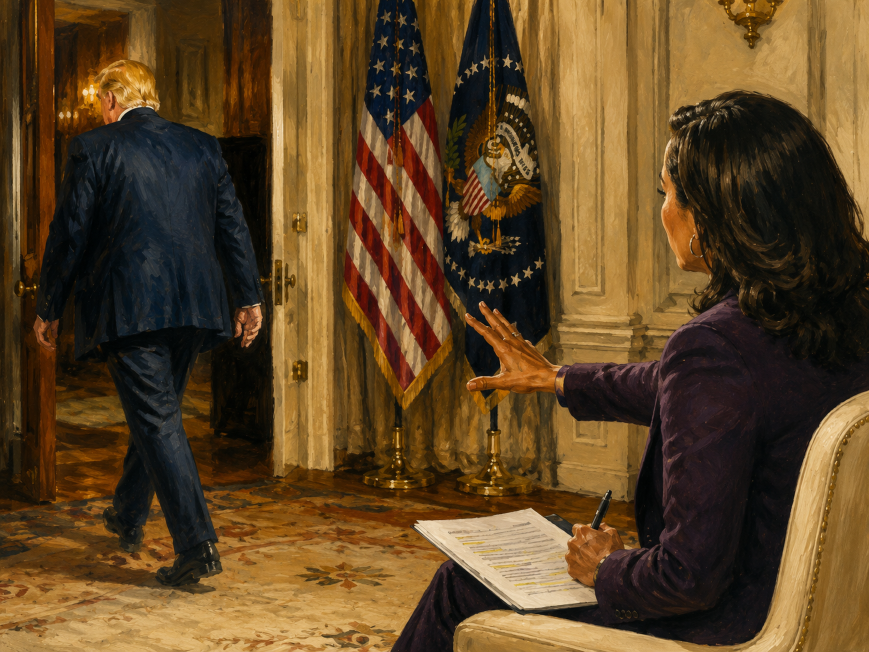
Source Video
NBC Full interview: Trump says Iran ‘is not an endless war’ as conflict reaches 100 days
The Quick Rebuke
MEDIA COVERAGE
Needs ContextViewers of this interview got real news: Iran still has a significant missile reserve, Mojtaba Khamenei is alive and part of the negotiating chain, and Trump has explicitly endorsed compensating January 6th defendants including those who clashed with police. What they didn't get was consistent scrutiny. The most consequential factual claims in the interview — about the scope of military destruction, the status of Iran's nuclear program, and the Venezuela operation — were treated as statements of record rather than claims requiring verification. Welker's adversarial posture was real and occasionally effective, but it was applied selectively in ways that a symmetric accountability standard would not produce. The interview is worth watching. It is not the rigorous reckoning its framing implies.
The Main Claim
What They Got Right
Welker identified the war's central legal contradiction on the record. Trump's own social media post referred to "final negotiations to end the war," a naval blockade is in place, and a naval blockade constitutes an act of war under international law. She surfaced that contradiction directly and early.
She extracted the interview's most newsworthy disclosures through disciplined follow-up. Trump's acknowledgment that Iran retains more than a fifth of its ballistic missile capacity came from Welker pressing for a ballpark figure after Trump declined to be specific. His confirmation that Mojtaba Khamenei — who has not been seen publicly — is part of the Iranian approval chain for any deal came from Welker correctly identifying who Trump was describing and pushing to confirm it on the record.
On January 6th, Welker held her ground with specific numbers. She cited the accurate figure that 172 people pleaded guilty specifically to assaulting police officers, pushed back on the FBI entrapment claim by noting no court has accepted it as a finding of fact, and refused to move on when Trump threatened to end the interview.
Her pushback on post-JCPOA enrichment acceleration was factually correct. After the U.S. withdrawal in 2018, Iran progressively stepped back from its JCPOA commitments, eventually reaching 84 percent uranium enrichment purity by early 2023 — just below weapons-grade — a level it never approached under the deal.
What Needs Context
Trump's "I built the military" claim is an exaggeration, but a more specific one than it appears. His first term did accelerate the F-35 program, launch Space Force, and prioritize hypersonic weapons development. The honest critique is that "I built it" erases the institutional continuity of the defense establishment, Congress's role in authorizations, and the career military leadership that executed those programs. Welker didn't push on any of that specificity.
The JCPOA deserved more critical examination than it received. Welker twice implicitly defended the deal by citing post-withdrawal enrichment escalation, without acknowledging the deal's most significant structural flaw: it placed no restrictions whatsoever on Iran's ballistic missile program, including missiles capable of carrying nuclear warheads. A nuclear agreement that caps enrichment while leaving the delivery system entirely unconstrained is not a comprehensive solution. That context is absent from Welker's framing of the deal as a set of "guardrails."
Trump's "five years ago" nuclear weapon claim is contested, not simply false. The deal's inspection architecture had documented gaps — Iran never permitted access to military sites, the IAEA noted unresolved questions about possible military dimensions of the program for years, and sunset clauses were structured to progressively lift enrichment restrictions between 2026 and 2031. The more defensible and important counter-argument — which Welker gestures toward but never develops — is that post-withdrawal enrichment acceleration actually moved the weapons timeline closer, not further away.
Trump's stock market claim is an undercount, not an exaggeration — but the framing is still selective. The Dow Jones Industrial Average recorded closer to 126 all-time highs during the relevant period, not 73. But Trump's second term has also produced some of the fastest correction drops in modern market history, with the president's own tariff announcements directly responsible for several of the worst single-day declines on record. Presenting the record highs without the record volatility that accompanied them is incomplete.
The January 6th prosecutorial picture is more complicated than the interview allows. Coercive plea dynamics in the January 6th cases are documented: some defendants were held in pretrial detention for extended periods while prosecutors stacked charges, and defense attorneys in multiple cases publicly described pressure to plead under threat of sentences that dwarfed what cooperation would produce. That does not mean the 172 assault pleas were false confessions — some conduct on video is unambiguous — but Trump's claim that plea pressure was a factor is not invented. Welker's use of the plea count as a dispositive counter-fact elides a genuine due process debate that legal scholars have engaged seriously.
The FBI's confirmed presence at January 6th is a distinction the interview collapses. Undercover agents and informants were present — the DOJ acknowledged this during subsequent trials. What remains unconfirmed is their operational role. Whether any were actively encouraging entry rather than observing is a meaningful open question, not a settled one.
Missing Facts
The "totally obliterated" nuclear site claim went unchallenged. Trump's assertion that the B-2 strikes completely destroyed Iran's nuclear facilities is contradicted by independent analysts who have raised genuine uncertainty about whether hardened underground facilities like Fordow were destroyed or merely degraded. The interview states the claim and moves on.
Trump denied post-JCPOA enrichment escalation and the denial stood. When Welker noted Iran's enrichment acceleration after the deal was terminated, Trump said flatly "they didn't escalate anything." Welker had just cited the correct counter-fact seconds earlier and did not repeat it after the denial. It went unaddressed on the record.
Internal administration contradictions were never raised. Trump's Iran envoy Steve Witkoff, when asked earlier in the week how the conflict ends, said "I don't know." Defense Secretary Pete Hegseth said in a separate interview the war was "only just the beginning." Trump told Welker a deal was imminent and the threat "largely over." None of those direct contradictions from his own team were put to him.
The anti-weaponization fund's eligibility structure went unexamined. Who determines valid claims, what standard of proof applies, and how political appointees would be insulated from eligibility decisions were never asked. That structural question is central to why the fund drew bipartisan opposition in Congress, and it was never raised.
California's vote-counting record under the same rules was not mentioned. Trump claimed multi-day counting constitutes active fraud. Welker correctly noted the process is legal and established, but did not note that Republicans have competed and won, although rarely, in California under the identical counting framework. the system should be scrutinized, it has tremendous risk of fraud, but that doesn't mean there is any. — which undercuts the fraud premise structurally rather than just procedurally.
Our Analysis
The structural problem with this interview is not what Welker got wrong on individual facts — her factual record is largely sound. The problem is the consistency of the adversarial standard. On January 6th and election fraud, she cited specific figures, said "there's no evidence of that" four times, and refused to move on until Trump responded. On Iran, she let pass without challenge: the claim that half the world would already be eradicated, the assertion that the nuclear site was "totally obliterated," the Venezuela military success framing, and Trump's flat denial of documented post-JCPOA enrichment acceleration. These are factual claims of equal or greater consequence to the public interest. The asymmetry is not random — it maps onto which claims are politically sensitive in which direction, and that mapping is the tell.
Access journalism carries an inherent structural cost that this interview illustrates. It was conducted at the White House's invitation, on a farm the president selected, interrupted multiple times by weather that disrupted interview rhythm, and carried out under conditions where Welker and her producer were audibly negotiating whether to pause. The setting systematically advantaged the subject. None of that is disqualifying — getting Trump on the record for an hour at 100 days into a war has genuine public value. But that value is only fully realized when the adversarial standard is applied without regard to which direction a claim cuts politically, and here it wasn't.
The Bottom Line
Viewers of this interview got real news: Iran still has a significant missile reserve, Mojtaba Khamenei is alive and part of the negotiating chain, and Trump has explicitly endorsed compensating January 6th defendants including those who clashed with police. What they didn't get was consistent scrutiny. The most consequential factual claims in the interview — about the scope of military destruction, the status of Iran's nuclear program, and the Venezuela operation — were treated as statements of record rather than claims requiring verification. Welker's adversarial posture was real and occasionally effective, but it was applied selectively in ways that a symmetric accountability standard would not produce. The interview is worth watching. It is not the rigorous reckoning its framing implies.
Sources
- 1. Verdict / Main Claim NBC News Meet the Press transcript, June 7, 2026:
- 2. What They Got Right IAEA reports on Iranian enrichment escalation post-2018:
- 3. What Needs Context — JCPOA missile program gap Arms Control Association, JCPOA overview
- 4. What Needs Context — Jan. 6 plea dynamics Politico reporting on Jan. 6 pretrial detention and plea pressure
- 5. Missing Facts — Witkoff / Hegseth contradictions
- 6. Missing Facts — IAEA post-withdrawal enrichment documentation
About the Author
Don Keyhoetea
Don Keyhoetea writes for Rebuke Nation, an independent publication focused on media analysis, political framing, and source-based accountability.
Never miss a critique.
Subscribe to our RSS feed and get every new fact-check and media analysis delivered directly to your reader — no algorithm, no noise.