
What CNN Got Right — and Wrong — About the Consumer Sentiment Record
By Don Keyhoetea · May 25, 2026 · 7 min read
High gas prices, cost of living send US consumer sentiment to all-time low
The Quick Rebuke
CNN'S COVERAGE
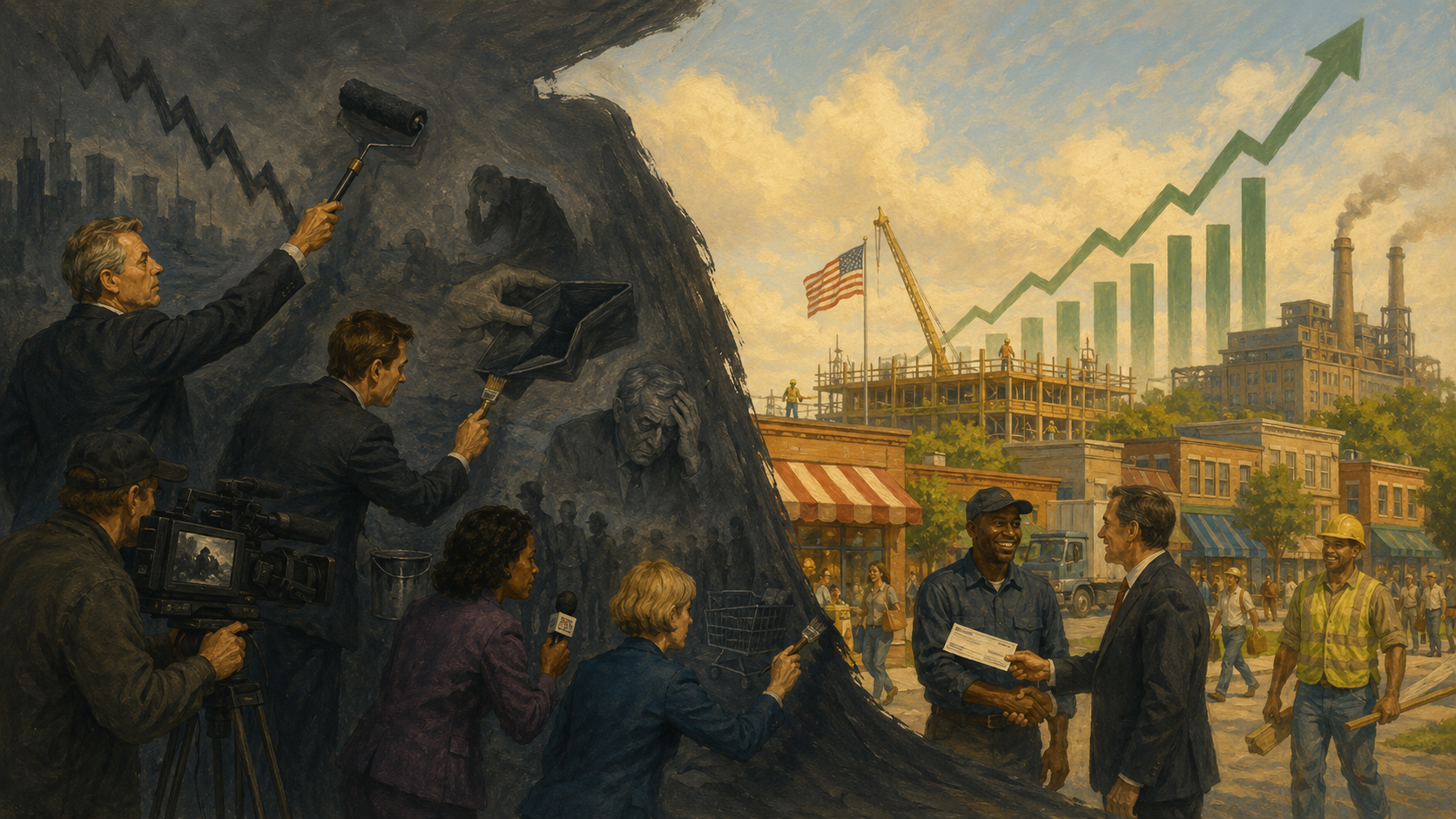
Needs ContextConsumer sentiment is at a record low. Americans are stressed about gas prices, inflation, and the economic fallout from the Iran war. All of that is true and important. What is also true — and almost entirely absent from coverage — is that the underlying economy is growing, actual inflation is far lower than the last time sentiment was this low, the index has a documented methodological controversy affecting historical comparisons, and a known partisan distortion effect inflates the magnitude of the reading. CNN and its peers reported the number accurately. They reported what it means incompletely. The result is coverage that confirms economic anxiety without giving readers the tools to assess how much of that anxiety tracks with economic reality — and how much of it is something else.
CNN's Main Claim
CNN reports that "Americans just loathe this economy," anchoring the claim on the University of Michigan Consumer Sentiment Index dropping to 44.2 — its third consecutive monthly decline and a new all-time low — driven by the US-Israeli war in Iran, oil supply shocks, and years of accumulated inflation.
What They Got Right
The core data is accurate. The University of Michigan's Consumer Sentiment Index dropped to a record low of 44.8 in May 2026, revised down from a preliminary 48.2, marking the third straight monthly decline as Strait of Hormuz supply disruptions continued to push gasoline prices higher.
The drivers are real and well-documented. The cost of living was the top concern, with 57% of consumers spontaneously citing high prices as eroding their personal finances, while lower-income consumers and those without college degrees posted the steepest declines — groups more sensitive to rising gas and essential costs.
The inflation expectations data is also alarming and accurately reported. Year-ahead inflation expectations climbed to 4.8%, while long-run expectations rose to 3.9% — notably higher than the 2.8% to 3.2% range seen throughout 2024.
And the political breadth of the decline is significant and correctly noted. The current decline is a rare moment of bipartisan agreement, with sentiment falling across the political spectrum as energy costs hit every household.
What Needs Context
The index measures feelings, not economic activity — and that gap is wider than ever.
Economists have pointed out for years that the gap between what consumers say in surveys and what they actually do has widened significantly. During the Biden administration, sentiment was persistently grim while actual consumer spending remained buoyant — a phenomenon economist Kyla Scanlon famously labeled a "vibecession." CNN's piece does not acknowledge whether that same gap exists now. Bitcoin and the Nasdaq both rallied even as the Michigan survey printed its historic reading — a divergence that suggests the relationship between sentiment and actual economic behavior is not straightforward. Reporting a sentiment score as evidence of how the economy is performing, rather than how people feel about it, conflates two different things.
The "all-time low" comparison has a known methodological problem CNN did not disclose.
In 2024, the University of Michigan transitioned from phone-based to online survey methodology. A Yale Budget Lab analysis found this switch produced a nearly 9-point decline in sentiment readings, even after adjusting for demographic differences. The University of Michigan itself acknowledged a 6.6-point difference attributable to the methodology change. The university chose not to apply adjustment factors, saying a single model would not suit the diverse needs of data users. This means the "all-time low" is being compared against a 74-year historical record collected under a different methodology. The record may still stand even with adjustment — but no mainstream outlet covering this story told readers about this controversy. CNN, NBC, CNBC, and the Associated Press all ran the "lowest since 1952" framing without a single word of caveat.
Partisan distortion in sentiment surveys is documented and was not mentioned.
A 2024 Richmond Fed study found that partisan identity has become the single strongest predictor of consumer sentiment responses — stronger than income, employment status, or actual economic conditions. Republicans and Democrats now report dramatically different economic experiences regardless of the underlying data, and those partisan gaps widen significantly when one party controls the White House. CNN does not mention this effect, which directly affects how the "bipartisan" framing should be interpreted. A decline that looks bipartisan on the surface may reflect something more complicated when disaggregated by partisan identity.
Missing Facts
Hard economic data tells a different story — and was largely absent.
GDP grew 2% in the first quarter of 2026, driven by increases in consumer spending, investment, and exports — identical to GDP growth in the first quarter of 2022, when sentiment was also near its then-record low. The inflation rate in April 2026 was 3.8%, elevated but dramatically lower than the 8.3% recorded in April 2022. Housing costs were slightly lower than the same period under Biden. Americans feel worse about the economy than at any point in recorded history — yet the economy is growing at 2%, unemployment remains near historic lows, and inflation is less than half what it was during the last sentiment low. That divergence is the most important economic story in this data. Almost no outlet led with it.
The "record low" comparison to 2022 is missing key context.
Every outlet compared today's reading to the June 2022 record low as if the situations were equivalent. They are not. In 2022, inflation was above 8% and rising. Today it is 3.8% and the economy is growing. The fact that sentiment is lower now than it was during peak pandemic-era inflation — when prices were rising twice as fast — raises a serious question about whether the index is capturing real economic conditions or something else. That question appeared in exactly one outlet: Fortune. It was absent from CNN, NBC, CNBC, and the Associated Press.
The survey's own director provided a nuance that was widely dropped.
Survey director Joanne Hsu noted that "earlier this year consumers may have reserved judgment about how long the Iran conflict would last" — suggesting the May decline reflects a shift in expectations about duration, not necessarily a new deterioration in actual conditions. That distinction — between worsening conditions and worsening expectations about conditions — is analytically important. It was present in some coverage and absent in most.
Our Analysis
The consumer sentiment story is real and significant. Record-low sentiment, sustained over three months, with bipartisan breadth, rising inflation expectations, and concentrated pain among low-income households — that is a legitimate economic story that deserves prominent coverage. CNN gave it prominent coverage. That part is correct.
What is not correct is the way the story was framed across virtually every outlet: as a comprehensive verdict on the state of the economy rather than as a report on how Americans feel about it. "Americans just loathe this economy" is an emotionally resonant framing that treats a perception index as economic fact. The more precise statement is: Americans feel worse about the economy than at any point in 74 years of recorded data, at a time when GDP is growing, unemployment is near historic lows, and inflation — while elevated — is a fraction of its recent peak. That framing is harder to write a headline around. It is also more honest.
The methodology omission is the most serious press failure here. Every major outlet reported an "all-time low since 1952" without mentioning that a significant portion of the historical comparison rests on data collected under a different method. That is not a minor technical footnote — it is directly relevant to whether the "record" framing holds. Axios documented this controversy in its own reporting back in 2024. Its own reporters apparently did not apply that institutional knowledge to their 2026 coverage of the same index.
The Bottom Line
Consumer sentiment is at a record low. Americans are stressed about gas prices, inflation, and the economic fallout from the Iran war. All of that is true and important. What is also true — and almost entirely absent from coverage — is that the underlying economy is growing, actual inflation is far lower than the last time sentiment was this low, the index has a documented methodological controversy affecting historical comparisons, and a known partisan distortion effect inflates the magnitude of the reading. CNN and its peers reported the number accurately. They reported what it means incompletely. The result is coverage that confirms economic anxiety without giving readers the tools to assess how much of that anxiety tracks with economic reality — and how much of it is something else.
Sources
- 1. https://tradingeconomics.com/united-states/consumer-confidence
- 2. Trump vs. Biden: Economies Compared as Consumer Sentiment Hits Record Low — Newsweek, May 22, 2026 (GDP and inflation comparison data)
- 3. Newsweek — Trump vs. Biden: Economies Compared — 8.3% inflation in April 2022 vs. 3.8% today
- 4. https://www.newsweek.com/trump-vs-biden-economies-compared-as-consumer-sentiment-hits-record-low-11984651
About the Author
Don Keyhoetea
Don Keyhoetea writes for Rebuke Nation, an independent publication focused on media analysis, political framing, and source-based accountability.
Never miss a critique.
Subscribe to our RSS feed and get every new fact-check and media analysis delivered directly to your reader — no algorithm, no noise.