
What 1876, 1926, and 1976 Reveal About the Mood of 2026
By Don Keyhoetea · July 4, 2026 · 2 min read
Bottom Line
America's 100th, 150th, and 200th anniversaries each arrived amid deep division and low national confidence. The 250th continues that pattern, with one measurable difference: national pride itself has become a partisan marker.
Why It Matters
Record-low pride heading into July 4, 2026 is widely presented as unprecedented decline. The historical record complicates that reading — and clarifies what is new, what is old, and what recovery has required before.
Background & Context
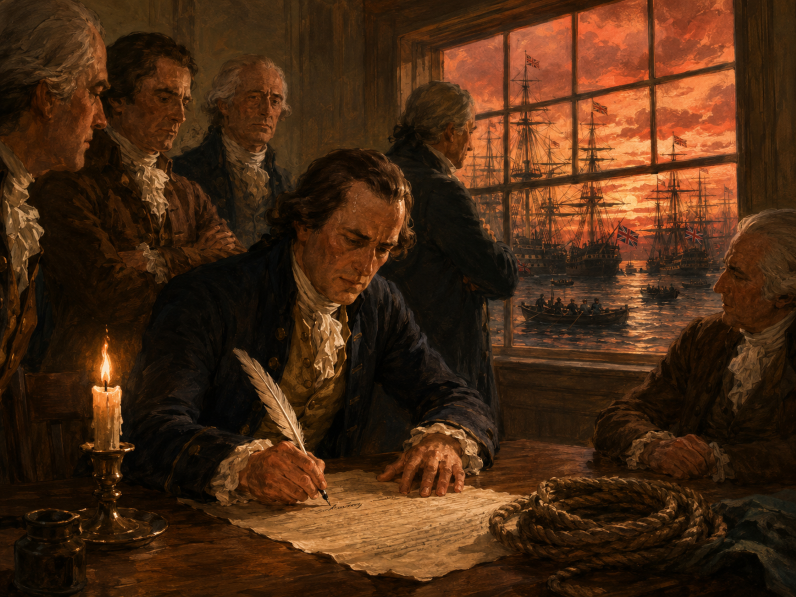
The nation was declared independent under direct military threat. In late June 1776, as the Continental Congress moved toward a vote on independence in Philadelphia, a British fleet under General William Howe began arriving in New York Harbor, ninety miles away. Over the following weeks the force grew to more than 400 vessels and roughly 32,000 soldiers and sailors — the largest expeditionary force Great Britain had ever assembled. The delegates received General Washington's dispatches from New York as they deliberated. They adopted the Declaration on July 4 with full knowledge that the instrument of their punishment was already at anchor. Most delegates signed the engrossed parchment on August 2; twenty-five days later, the Continental Army suffered its worst defeat of the war at the Battle of Long Island and lost New York.
The founding generation then spent decades fighting over how the government should function. The Articles of Confederation proved so weak that armed rebellion in Massachusetts went initially unanswered by any national authority. The Constitutional Convention of 1787 nearly collapsed over representation and slavery, and ratification passed only after a bitter public campaign. Within a decade, the Alien and Sedition Acts of 1798 saw newspaper editors jailed for criticizing the president. The election of 1800 required 36 House ballots to resolve. In 1804, the sitting Vice President killed the former Treasury Secretary in a duel. Political conflict was not an interruption of the founding era; it was its constant condition.
Each subsequent milestone anniversary landed in its own period of division. The centennial (1876), sesquicentennial (1926), and bicentennial (1976) are frequently remembered as celebrations. The contemporaneous record shows each occurred during serious political, economic, or institutional crisis. That record is the appropriate baseline for evaluating the mood surrounding the semiquincentennial.
The Evidence
1876: The centennial arrived eleven years after the Civil War, amid depression, scandal, and the most disputed election in American history. The Panic of 1873 had produced a prolonged economic depression. The Grant administration was mired in the Whiskey Ring scandal and the impeachment of Secretary of War William Belknap. News of the destruction of Custer's command at Little Bighorn reached the East during the celebration itself. That November, the Hayes-Tilden election produced contested returns in three states and dueling electoral slates; it was resolved only by the Compromise of 1877, which withdrew federal troops from the South and ended Reconstruction. Despite this, the Centennial Exhibition in Philadelphia drew nearly 10 million visitors — close to one-fifth of the national population.
1926: The sesquicentennial arrived during a raging culture war beneath surface prosperity. The Ku Klux Klan had reached its second-era peak, marching tens of thousands down Pennsylvania Avenue in 1925. The Scopes trial had turned the modernism-fundamentalism divide into national spectacle. The Immigration Act of 1924 followed a decade of nativist politics. The 1924 Democratic convention required 103 ballots, splitting in part over whether to condemn the Klan by name. The official Sesquicentennial Exposition in Philadelphia was poorly attended and lost money. The anniversary's most durable artifact is President Coolidge's July 5, 1926 address, which argued the Declaration's propositions were final — that anyone denying them could proceed historically only backward, toward the time before equality and individual rights.
1976: The bicentennial arrived at the lowest point of institutional confidence in the 20th century. President Nixon had resigned in August 1974. Saigon fell in April 1975. Stagflation gripped the economy, and New York City stood at the edge of bankruptcy. The Church Committee had spent 1975 documenting decades of intelligence-agency abuses. The original federal plan for a bicentennial world's fair had collapsed. The celebration that occurred instead was decentralized — tall ships in New York Harbor, local parades, community events — and was broadly judged a success despite the national mood preceding it.
2026: Measured national pride is at its recorded low. Gallup's June 2026 survey finds 33% of U.S. adults saying they are "extremely proud" to be American — the lowest in the trend dating to 2001, down eight points in one year, one of the largest single-year drops recorded. In 2001, when tracking began, 55% expressed extreme pride. Pew found 29% satisfied with the country's direction in January 2026, and NBC News/Roper polling found most Americans believe the country's best years are behind it.
The 2026 division runs along partisan lines to a degree the earlier record does not show. Gallup records 70% of Republicans expressing extreme pride against 14% of Democrats — a 56-point gap, at or near the highest on record. Combining "extremely" and "very" proud, Republicans stand at 93%, independents at 51%, and Democrats at 27%, with the latter two at record lows. The decline sits atop a longer trend: Gallup's confidence-in-institutions measure fell from 43% in 2004 to 26% by 2023 — a trajectory spanning administrations of both parties.
The Analysis
The evidence does not support the claim that 2026 represents an unprecedented level of national division. By most objective measures, 1876 was worse: the country was one decade removed from a war that killed roughly 750,000 Americans, in economic depression, and about to endure an electoral crisis resolved through a bargain whose costs fell on Black Southerners for generations. The 1976 environment — a presidential resignation, a lost war, exposed intelligence abuses, and economic stagnation compressed into three years — also compares unfavorably to the present on institutional-crisis grounds.
What the evidence does support is that the low mood preceding an anniversary has not historically predicted the anniversary's outcome. The 1876 exhibition drew enormous crowds despite depression and scandal. The 1976 celebration succeeded despite expectations of a hollow observance — and its success is generally attributed to its decentralization, which allowed citizens to celebrate the country as distinct from the government they distrusted.
The evidence also supports a second conclusion: recovery from these periods was produced by choices, not by passage of time. The 1877 settlement purchased sectional peace at a documented moral cost. The post-1976 recovery in confidence followed specific political and economic developments, not automatic reversion. Historical resilience is real in the American record, but the record shows it as earned rather than guaranteed.
One feature of 2026 is without clear precedent in the anniversary record: pride in the country itself now functions as a partisan identifier. The 1876 divide was regional. The 1926 divide was cultural and religious. In 1976, distrust of institutions was broadly shared across party lines while national pride remained bipartisan. Gallup's generational data shows the current pattern is also compounding: each successive generation reports lower pride than the one before, with declines concentrated most heavily among younger Democrats. A division that maps onto partisan identity and deepens by cohort behaves differently from a regional or cultural division; it fluctuates with which party holds power and is therefore less likely to resolve through any single election.
The founding record reframes what political conflict signifies. The Declaration was adopted under the guns of an invasion fleet, and the men who signed it spent the following thirty years in political combat with one another that included jailed editors, a deadlocked election, and a fatal duel between senior statesmen. The constitutional system was designed by people in active, bitter disagreement — and designed on the assumption that such disagreement would be permanent. Political fighting is not evidence that the founders' framework has failed. It is the condition the framework was built to contain, and has contained, for 250 years.
Conclusion
The historical record establishes that America has marked every major anniversary of its founding during a period its own citizens regarded as fractured, and that the founding itself occurred under conditions worse than any anniversary since. The delegates of 1776 signed with an invasion fleet in view. The Americans of 1876 celebrated between a civil war and a constitutional crisis. The Americans of 1926 celebrated amid open cultural warfare. The Americans of 1976 celebrated at the bottom of a confidence collapse — and found the celebration itself restorative once it belonged to communities rather than to Washington.
The record equally establishes that endurance was never automatic. Each recovery required people who concluded the country was worth the work and acted on that conclusion — at costs that were sometimes severe and unevenly borne. The present moment carries one burden the earlier anniversaries did not: a citizenry whose pride in the nation now divides along party lines and thins with each generation. That is a problem no single election resolves, because it reverses with every transfer of power.
Even after 250 years, we still fight. We still argue. And hopefully, it is all for the better.
We are still a young nation. Our founding fathers had a vision, and they set it down in some of the most important documents the world has ever known — documents written to preserve the freedom of a people. Today, we have strayed from what those men intended. We have a lot of work left to do. But we still fight for our freedom, and that fight is the inheritance.
So first, love this country. Then fight for it.
Our founding fathers signed a document that fitted each of them for a noose — to preserve Life, Liberty, and the pursuit of Happiness — while the enemy holding that noose sat anchored at their doorstep. If they could do that, what can't we do?
About the Author
Don Keyhoetea
Don Keyhoetea writes for Rebuke Nation, an independent publication focused on media analysis, political framing, and source-based accountability.
Never miss a critique.
Subscribe to our RSS feed and get every new fact-check and media analysis delivered directly to your reader — no algorithm, no noise.