
Vance Fought to Release the Epstein Files. Three Times. HuffPost, The Hill, and the Daily Beast Called It a Cover-Up.
By Don Keyhoetea · June 12, 2026 · 10 min read
The Quick Rebuke
MEDIA COVERAGE
MisleadingThe NYT's Situation Room reporting is significant and the underlying accountability questions are real. What HuffPost, The Hill, and the Daily Beast did with that reporting is a different matter entirely. All three took a Democratic press statement, checked it against nothing, and published it as the conclusion of a report that said the opposite. The NYT did not call Vance the cover-up architect. Garcia did. HuffPost, The Hill, and the Daily Beast amplified Garcia's framing without the basic step of asking whether it matched the article Garcia was citing — an article that shows Vance arguing to release files that could damage the president, being overruled by Wiles, and losing that argument three times. The person who created the crisis was Bondi. The person who blocked disclosure was Wiles. The person who wanted the issue buried was Trump. The person who fought for transparency and lost was Vance. Readers who relied on HuffPost, The Hill, or the Daily Beast got a story the evidence does not support.
The Main Claim
What They Got Right
The meetings themselves are documented and newsworthy. Senior officials including Vance, Wiles, Bondi, Patel, Blanche, Bongino, Leavitt, Blair, Cheung, Budowich, Warrington, and Woodward were involved at various points. The administration spent months in internal conflict over the Epstein files. Garcia's demand for testimony is a legitimate news event. HuffPost, The Hill, and the Daily Beast got those basic facts right.
The Hill included the accurate account — but buried it. Four paragraphs into its piece, The Hill accurately described what the NYT actually reported: that Vance urged Cabinet officials to release the Epstein files, asserting that a slow congressional rollout would only worsen the scandal. That sentence directly contradicts the cover-up framing in The Hill's own headline. The Hill published both without noting the contradiction. That the accurate account made it in at all is worth acknowledging, even as the burial of it is worth criticizing.
What Needs Context
The NYT report is based on leaked, anonymous sourcing — and that matters. The Haberman-Swan book draws from over a thousand interviews conducted over three years, largely with unnamed officials. That does not make the reporting false. But it means the account of what happened in those Situation Room meetings has not been independently verified by documentary evidence. Treating it as fully established fact — as HuffPost, The Hill, and the Daily Beast all did — overstates what the sourcing can support.
Someone leaked this — and the leak serves a specific narrative. The Situation Room discussions were not public. Someone with access to those meetings decided to share the details with Haberman and Swan. The account that emerged portrays Vance as erratic and "not on Trump's side." Susie Wiles is the only named on-the-record source in the surrounding coverage, and she publicly trashed Bondi in Vanity Fair. The leak pattern is consistent with sourcing that serves Wiles's interests rather than Vance's. HuffPost, The Hill, and the Daily Beast covering this story never asked who benefited from the specific details that made it into the book.
Bongino's resignation is not incidental. Bongino left the FBI shortly after this period. The NYT documents him as the most vocal internal opponent of the non-disclosure strategy — the person who stormed out of the Situation Room rather than endorse it. His departure is worth scrutinizing. It is possible he resigned because the truth he wanted out was not coming out on his terms. That is speculative, but the timeline is notable and HuffPost, The Hill, and the Daily Beast examined none of it.
Garcia's "strictly opposed to transparency" claim was printed without a fact-check. The administration ultimately signed the Epstein Files Transparency Act and released millions of pages of Epstein-related documents. Calling an administration that released millions of pages of files "strictly opposed to transparency" is a specific factual overclaim. HuffPost and The Hill both printed Garcia's characterization without testing it against the public record.
Missing Facts
The NYT did not frame Vance as the cover-up architect — HuffPost, The Hill, and the Daily Beast did. This distinction matters and none of the three make it. The NYT portrayed Vance as a figure who pushed for transparency and was overruled. The cover-up framing came from Rep. Garcia in a press statement, was picked up by HuffPost, The Hill, and the Daily Beast, and was presented as though it reflected the NYT's own conclusions. It did not.
HuffPost invented a phrase and put it in the sub-headline. HuffPost's sub-headline reads: "The vice president reportedly held a series of secret meetings in the Situation Room last year to discuss how to shield Trump from fallout over the Epstein Files." The phrase "to shield Trump" appears nowhere in the NYT article. It is not a quote from Garcia. It is not a quote from anyone. HuffPost inserted its own editorial conclusion into a sub-headline formatted to look like a factual description of reported events. That is not framing. That is fabrication.
The Hill let Garcia's characterization stand without examination. Garcia told reporters: "JD Vance is now part of this massive cover-up... he's leading those meetings, he's talking about protecting the president." The Hill published this without noting that the NYT report Garcia was citing describes Vance doing the opposite — arguing to release files that could damage the president. The accurate account was four paragraphs away in The Hill's own story. The Hill connected none of it.
The Daily Beast contradicted itself in the same article. The Daily Beast headlined its piece: "White House's New Epstein Scapegoat Is Revealed as JD Vance." A scapegoat is someone blamed for something they did not do. The Daily Beast then covered Vance as a perpetrator of the cover-up he was supposedly being scapegoated for. Both framings cannot simultaneously be true. The Daily Beast published them in the same story without registering the contradiction.
Bondi created the crisis — not Vance. The entire firestorm began when Bondi told Fox News in February 2025 that a client list was "sitting on my desk right now to review." The White House had no idea she was going to say it. The claim was false. There was no client list. Six days later, Bondi distributed binders of largely public documents to right-wing influencers without White House vetting. The Situation Room meetings Vance presided over were convened specifically to manage the fallout from that false claim. HuffPost, The Hill, and the Daily Beast all focused on who was in the room trying to put out the fire — none of them identified who lit it.
Bondi was pushed out because of how she handled it. Bondi's tenure ended with her legacy inextricably linked to the Epstein mismanagement. Wiles told Vanity Fair publicly that the client list "sure as hell wasn't on her desk" and called the binders "full of nothingness." Bongino confronted her directly: "You fucked this thing up from the start." Patel and Bongino both told Wiles that Bondi needed to go. Her departure was a direct consequence of the Epstein mismanagement — not incidental to it. HuffPost, The Hill, and the Daily Beast did not connect those dots.
Bongino's position was the opposite of the cover-up narrative. Bongino hated the DOJ memo declaring there was no client list. He objected to putting the FBI seal on it. He was overruled. He confronted Bondi. He stormed out of the Situation Room when Wiles tried to get him to endorse the management strategy. He told advisers he was done. He stayed only because he was persuaded that resigning would damage Trump — and he privately seethed while doing it. Democrats are naming Bongino in their cover-up demands. The NYT's own account shows he was the most vocal internal opponent of the strategy he is being accused of supporting. HuffPost, The Hill, and the Daily Beast did not report any of it.
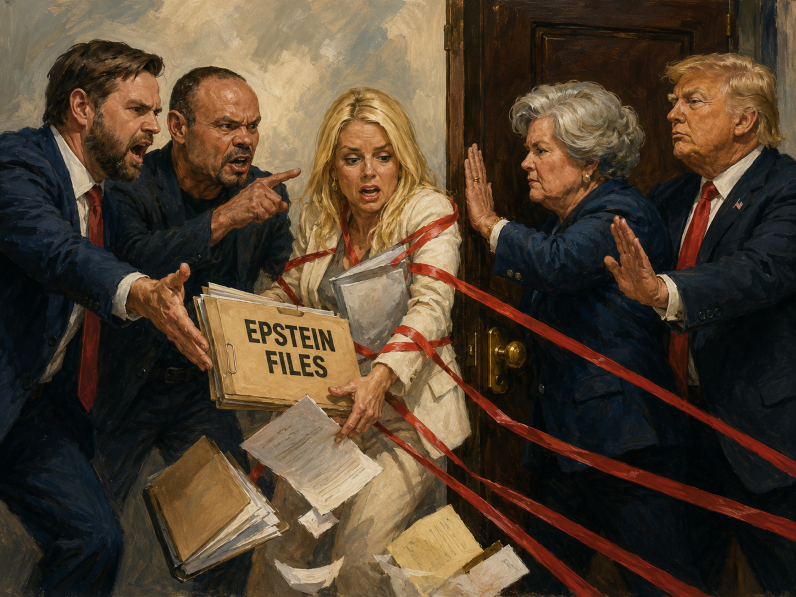
Vance argued for releasing the files three times and was overruled three times. The NYT is explicit and specific.
July 17 meeting: Vance told the group that even unsubstantiated allegations about Trump should be released immediately — that voluntary full disclosure would at least earn the administration credit for transparency.
August 13 meeting: Vance again pushed to release as much as possible and proposed himself for a Joe Rogan interview to manage the messaging.
The nipple document: When a specific unverified allegation about Trump came up for discussion, Vance said it should be included in the public release. Wiles shut it down: the president would not be OK with it.
Three meetings. Three transparency arguments. Three over-rulings by Wiles acting on Trump's behalf. The NYT is unambiguous: Trump "had no interest in releasing anything. He wanted the whole Epstein issue buried." Garcia's claim that Vance was "talking about protecting the president" is the precise opposite of what the source Garcia cited actually documents. HuffPost, The Hill, and the Daily Beast printed Garcia's claim. None of them printed that correction.
Our Analysis
The accountability story here is real — just not the one HuffPost, The Hill, and the Daily Beast chose to tell. Senior White House officials held classified meetings to manage political fallout from a case involving a convicted sex trafficker who had a documented relationship with the president. That is significant. The question of whether those meetings crossed from crisis management into evidence suppression is worth investigating seriously.
That investigation does not require misrepresenting what the source material says. The NYT is clear about who did what. Vance pushed for transparency. Wiles blocked it. Trump wanted it buried. Bondi created the original crisis with a false claim on live television. Bongino fought the cover-up from the inside and eventually walked out.
HuffPost, The Hill, and the Daily Beast all had access to the same NYT article. The Hill even included the accurate account of Vance's position inside its own piece. All three chose to lead with Garcia's characterization rather than measure it against the evidence. Garcia made a political argument. HuffPost, The Hill, and the Daily Beast treated it as a factual finding. Those are different things, and maintaining that distinction is the press's job.
The Vance narrative is simpler and has a sitting vice president attached to it. Simpler is not the same as accurate. HuffPost, The Hill, and the Daily Beast chose the simpler story — and their readers got a version of events the evidence does not support.
The Bottom Line
The NYT's Situation Room reporting is significant and the underlying accountability questions are real. What HuffPost, The Hill, and the Daily Beast did with that reporting is a different matter entirely. All three took a Democratic press statement, checked it against nothing, and published it as the conclusion of a report that said the opposite. The NYT did not call Vance the cover-up architect. Garcia did. HuffPost, The Hill, and the Daily Beast amplified Garcia's framing without the basic step of asking whether it matched the article Garcia was citing — an article that shows Vance arguing to release files that could damage the president, being overruled by Wiles, and losing that argument three times. The person who created the crisis was Bondi. The person who blocked disclosure was Wiles. The person who wanted the issue buried was Trump. The person who fought for transparency and lost was Vance. Readers who relied on HuffPost, The Hill, or the Daily Beast got a story the evidence does not support.
About the Author
Don Keyhoetea
Don Keyhoetea writes for Rebuke Nation, an independent publication focused on media analysis, political framing, and source-based accountability.
Never miss a critique.
Subscribe to our RSS feed and get every new fact-check and media analysis delivered directly to your reader — no algorithm, no noise.