
Trump Says Iran Agreed to Everything. The Document He Signed Says the Talks Haven't Started.
By Don Keyhoetea · July 7, 2026 · 6 min read
The Quick Rebuke
MEDIA COVERAGE
MisleadingTrump claims Iran has "agreed to just about everything we need." The signed MOU defers every hard issue to future talks, and Iran drone-attacked two tankers days earlier. Coverage relayed the claim without checking the public text.
Why It Matters
The MOU's full text has been public since June 18. When outlets transmit official claims without measuring them against the document both governments signed, readers cannot tell diplomacy from spin.
The Main Claim
What They Got Right
The quotes are real and accurately transcribed. Trump said what the outlets reported he said. No outlet fabricated or distorted the CNBC remarks, and several — notably Times of Israel — included useful counterweight, flagging that Iran's no-nuclear-weapons pledge repeats the same commitment from the 2015 deal Trump withdrew from, and that Iran has denied his earlier claim that it agreed to surrender its enriched uranium stockpile.
The shooting was covered accurately as it happened. CENTCOM's account of the June 25 drone attack on the cargo ship Ever Lovely, the June 27 strike on the tanker Kiku carrying two million barrels of crude, the US retaliatory strikes, and Iran's counterstrikes on US positions in Kuwait and Bahrain were all reported promptly and sourced properly.
The document itself was published. NPR obtained and published the full 14-point text of the Islamabad Memorandum of Understanding on June 18. The raw material for accountability journalism has been sitting in public view the entire time. That is precisely what makes the failure that followed avoidable.
What Needs Context
The MOU is a list of agreements to negotiate, not a list of agreements. Article 3 commits both sides to reaching a final deal within 60 days. Article 8 — the nuclear provision — states the parties "have agreed to resolve the disposition of stockpiled enriched material pursuant to a mechanism that will be mutually agreed upon" and "agree to discuss the issue of enrichment." An agreement to discuss is the opposite of an agreement. Article 9 goes further: pending a final deal, Iran "will maintain the current status quo of its nuclear program." The word denuclearization appears nowhere in the document. The only nuclear commitment Iran actually made — reaffirming it will not procure or develop nuclear weapons — is the same pledge it made in the 2015 deal.
Iran's chief negotiator is quoting Trump's own document, and coverage frames it as stonewalling. Mohammad Bagher Ghalibaf's position — no final-deal talks until MOU implementation begins — has been widely presented as Iranian brinkmanship. But Article 13 of the MOU states that final-deal negotiations start only "subject to the beginning of the implementation" of Articles 1, 4, 5, 10, and 11. Those are the exact five articles Ghalibaf cited on Iranian state television as prerequisites. Whatever else can be said about Tehran's conduct, this particular demand is not a new condition. It is a recitation of the document the president signed. No major US outlet has made that explicit.
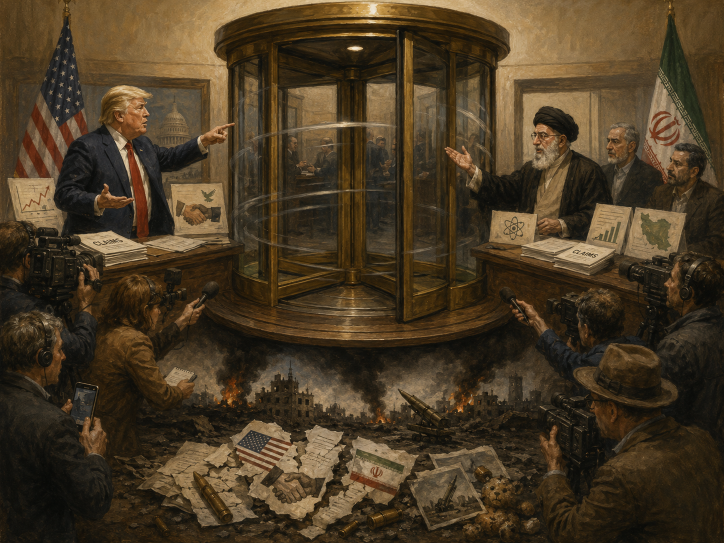
The claim and its refutation appear in the same interview. Trump told CNBC: "I hit them three times last week very hard because they sent a drone into a ship... I hit them three nights in a row, the week before I hit them two nights in a row... And we're negotiating... I think they've agreed to just about everything we need." A party that has agreed to just about everything does not typically require bombing five nights in two weeks. The internal contradiction required no outside sourcing to identify. It went unflagged.
Both sides invoke the MOU to justify shooting, and the text permits it. The US framed its strikes as enforcing Article 5's safe-passage commitment. Iran's Revolutionary Guard justified its tanker attacks by citing "a violating ship" on "an unauthorized route" and Israeli operations in Lebanon under Article 1. Article 5's actual language — Iran will make "best efforts" for safe passage, subject to de-mining and a future administration of the strait to be defined with Oman — is elastic enough to sustain both readings. The MOU's structure created a loop: each side's enforcement of its own reading delays the implementation the other demands. Coverage reports each strike as an episode. The structural problem goes unexamined.
Missing Facts
Our Analysis
The pattern here is transmission without measurement. Every claim examined in this review can be checked against a single public document that has been available since June 18. Trump's "denuking of Iran" cannot survive contact with Article 9. His "agreed to just about everything" cannot survive contact with Articles 3, 8, and 13 — or with his own description, moments later, of bombing Iran five nights in two weeks. Ghalibaf's implementation demand, framed across coverage as defiance, turns out to be a paraphrase of Article 13. None of this requires investigative resources. It requires reading fourteen paragraphs.
Both governments are describing a deal that does not exist. Trump describes surrender terms Iran never signed. Iranian officials describe US obligations — including frozen-asset figures that appear nowhere in the text — as settled commitments. Each side is negotiating through the press, and the press is serving as the delivery mechanism. The frozen-assets record is the cleanest demonstration: four different figures and two flatly contradictory accounts of what was agreed in Doha, each transmitted by outlets relaying whichever number their sources supplied.
The result is that readers cannot locate the truth between the claims. A reader following this story through mainstream coverage would reasonably conclude either that Iran has capitulated or that the US is violating its commitments, depending on which outlet they read. The signed text supports neither conclusion. It supports a narrower and more useful one: the two governments agreed to stop shooting, mostly have not, and deferred every consequential question to negotiations that — by the document's own terms and both sides' conduct — have not yet begun.
The Bottom Line
Trump claims Iran has "agreed to just about everything we need." The signed MOU defers every hard issue to future talks, and Iran drone-attacked two tankers days earlier. Coverage relayed the claim without checking the public text.
Sources
- 1. Islamabad Memorandum of Understanding, full text — NPR, June 18, 2026
- 2. Trump CNBC interview remarks, July 2, 2026
- 3. "Trump claims 'spoiled child' Iran has agreed to most US demands in negotiations" — Times of Israel, July 3, 2026
- 4. "U.S. strikes multiple targets in Iran in response to tanker attack" — NPR, June 27, 2026
About the Author
Don Keyhoetea
Don Keyhoetea writes for Rebuke Nation, an independent publication focused on media analysis, political framing, and source-based accountability.
Never miss a critique.
Subscribe to our RSS feed and get every new fact-check and media analysis delivered directly to your reader — no algorithm, no noise.