
The Documents Neither Side Read: Coverage of Trump's Election Address Failed in Opposite Directions
By Don Keyhoetea · July 18, 2026 · 10 min read
The Quick Rebuke
MEDIA COVERAGE
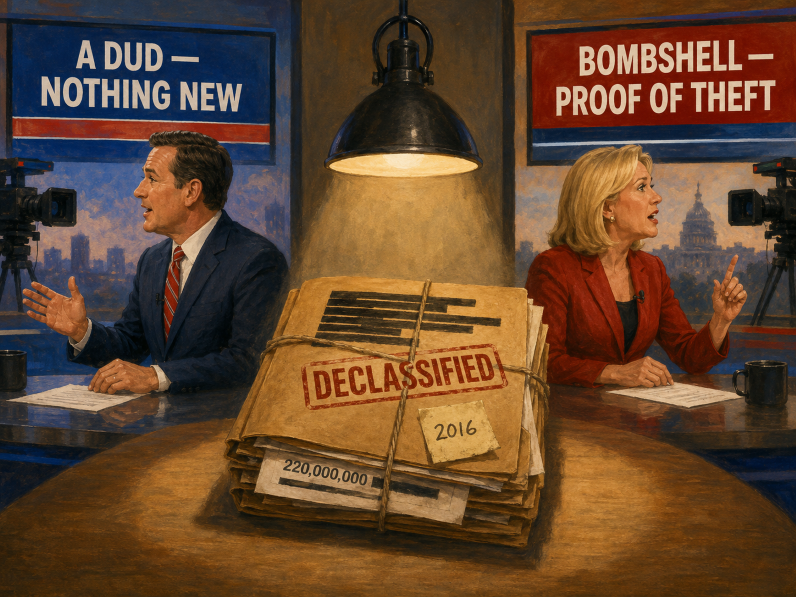
MisleadingMainstream coverage framed the July 16 release as old, public data. Conservative coverage framed it as proof of theft. The documents contradict both — and no major outlet read them closely enough to notice.
Why It Matters
Readers were handed two competing narratives, neither built from the primary documents. The actual record — real foreign data collection paired with unsupported electoral claims — was available to anyone who read the release.
The Main Claim
What Needs Context
The "publicly available data" framing does not survive the document inventory. The White House release describes voter data across 18 states as "bought, stolen, or hacked" — three verbs. Mainstream coverage substantially reported only the first. One released document itemizes the holdings: 204,822,241 records of unspecified U.S. voter data acquired in 2016; a named state voter database of 1,746,069 records acquired in 2017 containing voter IDs, full names, current and previous addresses, birth dates, gender, and phone numbers; a second named state database of 7,893,248 records containing citizenship information; and, beyond voter files entirely, approximately 28 million records from a U.S. citizen medical database including Social Security numbers. Voter IDs, birth dates, citizenship flags, and medical records with SSNs are not fields obtainable from commercial voter-file scraping. Those tranches indicate database compromises. Reporting that emphasized the six-state commercial-download document while omitting the itemized non-public holdings gave readers an incomplete picture of what the release actually shows.
The targeting analysis was the intelligence story, and it went largely unreported. The released documents state that the PRC conducted analysis of voter registration information from 18 states to support identity matching that could help identify "important U.S. targets." That is counterintelligence tradecraft — using voter files as a matching layer against other stolen datasets — and it aligns with a decade of documented Chinese bulk collection: the OPM breach, Anthem, Equifax, and Marriott. The espionage dimension of the release was more substantiated than its electoral dimension, and coverage on both sides largely ignored it in favor of relitigating 2020.
The "deliberately massaged" email deserved independent examination. Among the declassified materials is a November 20, 2020 email in which a strategic intelligence analyst describes having "deliberately massaged" a pending Presidential Daily Brief "to avoid any direct links to the election." This document does not prove a cover-up; analytic judgment about weak sourcing is a legitimate alternative explanation. But it corroborates a finding that predates this release: the DNI's analytic ombudsman, Barry Zulauf, reported in January 2021 that analysts were reluctant to fully report China election-interference intelligence and that Russia and China intelligence were handled under differing standards. An internal email consistent with a contemporaneous ombudsman finding is a story on its own terms. Mainstream coverage largely declined to engage it; conservative coverage presented it as dispositive proof. Neither treatment served readers.
The machine-vulnerability consensus has three parts, and coverage habitually reports two. The expert record holds simultaneously that voting equipment has real, documented vulnerabilities — CISA confirmed nine in Dominion ImageCast X devices in 2022, and court-supervised examination in Georgia demonstrated exploitability; that no evidence exists these vulnerabilities were exploited to change an election outcome; and that the confidence behind the second point rests on paper ballots and audits, which now back the overwhelming majority of U.S. votes. Coverage of the speech tended to report the second point as a rebuttal while omitting the first, treating "not exploited" and "not exploitable" as interchangeable. They are not, and the researchers who documented the vulnerabilities have said so consistently since before 2020.
The network airing decisions were a legitimate story with context on all sides. Fox News and the Fox broadcast network carried the speech in full while stating on air that Fox had not seen the evidence and was not in a position to evaluate the accuracy of the president's claims. CBS and MS NOW aired portions before cutting away for fact-checking; CNN kept the speech off its main channel entirely, covering it through digital platforms. Networks have long exercised this judgment — ABC, CBS, and NBC declined to carry President Biden's 2022 "threats to democracy" address for parallel reasons. Coverage of the airing controversy rarely disclosed the relevant business context: Fox's $787.5 million settlement of the Dominion defamation suit over false 2020 election claims, and CBS parent Paramount's pending FCC approval for a major acquisition under ownership with ties to the president. Every network's decision has a plausible non-editorial motive attached, and readers were told almost none of it.
The burn-bag claim cannot yet be evaluated — and coverage should have said exactly that. Trump alleged the discovery of burn bags containing information he attributed to President Obama, disclosed none of the contents, and ordered an interagency investigation. Nothing about the bags appears in the released document set. There is a documented precedent — the FBI's 2025 discovery of burn bags containing Trump-Russia probe materials, including the unreleased Durham report annex, which prompted a Justice Department mishandling investigation — but precedent is not contents. One checkable detail went unflagged by every outlet reviewed: the speech attributes the bags to Obama, who left office in January 2017, while the election intelligence at the center of the address dates to 2020 and later. Those facts cannot attach to the same documents. The correct journalistic posture was "asserted, contents undisclosed, timeline unresolved." Almost no outlet adopted it.
The speech's own timeline contradicts its headline claim, and no outlet caught it. The address stated that China's data acquisition began "during the 2020 election cycle." The largest itemized tranche in the released documents — more than 204 million records — is dated 2016. This discrepancy cuts against the speech's framing, was checkable within the release itself, and appeared in no mainstream or conservative coverage reviewed for this critique. Its absence on both sides indicates that outlets characterized the documents rather than reading them.
Missing Facts
The release itemizes acquisitions that no coverage inventoried. One released document lists 204,822,241 records of U.S. voter data acquired in 2016; a named state voter database of 1,746,069 records acquired in 2017 containing voter IDs and birth dates; a second named state database of 7,893,248 records including citizenship information; and approximately 28 million records from a U.S. citizen medical database including Social Security numbers. The same document set records a detail cutting the other direction: a Chinese actor's unsuccessful attempt to download an Ohio voter registration application from the state government website. The documents further state that the PRC analyzed voter registration information from 18 states for identity matching to help identify "important U.S. targets."
The intelligence-handling dispute predates this release and is documented. A declassified November 20, 2020 email describes a Presidential Daily Brief that was "deliberately massaged" to avoid direct links to the election. That email is consistent with the DNI analytic ombudsman's January 2021 report, which found analysts were reluctant to fully report China election-interference intelligence and that differing analytic standards were applied to Russia and China reporting. Coverage that treated the cover-up claim as invented, and coverage that treated it as proven, both omitted the ombudsman record that gives the email its meaning.
The vulnerability and precedent records are established and were available to every newsroom. CISA's June 2022 advisory confirmed nine vulnerabilities in Dominion ImageCast X ballot-marking devices used in multiple states, while finding no evidence of exploitation in elections. Foreign acquisition of U.S. voter data has direct precedent: Russian GRU officers exfiltrated roughly 500,000 voter records from Illinois in 2016 per federal indictment, and Iranian hackers obtained state voter data in 2020 and used it to send threatening emails to registered Democratic voters, resulting in federal indictments. These cases establish both that the collection pattern is real and that its documented uses have been intimidation and influence rather than vote manipulation.
The airing controversy had checkable context on every side. Fox News stated on air during the speech that it had not seen the evidence and could not evaluate the accuracy of the president's claims. ABC, CBS, and NBC declined to air President Biden's September 2022 address on threats to democracy — the direct precedent for the July 16 decisions, cited almost nowhere. And much of the voter data described in the release was acquired through purchase or download from commercial sources, a transfer that remains lawful because Congress has not restricted data-broker sales to foreign entities — the policy gap underneath the entire story, which no outlet on either side addressed.
Our Analysis
Two composite narratives were built from the same release, and the documents support neither. The mainstream composite — public data, nothing new, false claims — required omitting the itemized non-public database holdings, the medical records, the targeting analysis, and the PDB email. The conservative composite — theft, hack, cover-up proven — required omitting the documents' own statements that motivation is unknown, that much of the acquisition was purchased or downloaded, and that the collection timeline begins four years before the speech says it does. Each side's coverage was assembled from accurate individual sentences arranged into a conclusion the primary record does not support.
The failure pattern is omission calibrated to audience expectation. No fabrication was necessary. Outlets that expected the release to be empty found the documents confirming emptiness and stopped reading; outlets that expected a bombshell found the bombshell language and stopped reading. The shared tell is the 2016 date on the largest data tranche — a detail that undermines the speech, sat in the release itself, and appeared nowhere. A detail that inconveniences both narratives going unreported by both sides is the clearest available evidence that the documents were characterized secondhand rather than examined.
The release contained a real story, and it was not the one anyone told. Stripped of the electoral framing, the documents describe a hostile intelligence service assembling identity-resolution infrastructure on the American population — voter files fused with medical records and prior bulk thefts — much of it acquired legally through a data-broker market Congress has declined to regulate. That is a national security story with bipartisan stakes and no 2020 valence. It was available to every newsroom that received the release. The choice to cover the speech as another round of the 2020 argument, rather than to cover the documents, was an editorial decision made nearly universally, and readers on every side finished the week knowing less about the actual contents than the release made possible.
Uncertainty that remains should be stated plainly. The itemized record counts originate in heavily redacted documents whose sourcing cannot be independently assessed; raw intelligence reporting is often incomplete or wrong, a caveat that applies to the release's most alarming figures as much as to its most mundane. The burn-bag contents are undisclosed and under investigation. The motive behind the November 2020 PDB email — politicization or analytic caution — is unresolved on the current record. The Michigan investigation documents describe FBI interviews and allegations that have not been tested in court. Where this critique asserts what the documents say, it asserts only that; what the documents prove is a narrower set, and every outlet reviewed, in both directions, blurred that line.
The Bottom Line
Mainstream coverage framed the July 16 release as old, public data. Conservative coverage framed it as proof of theft. The documents contradict both — and no major outlet read them closely enough to notice.
Sources
About the Author
Don Keyhoetea
Don Keyhoetea writes for Rebuke Nation, an independent publication focused on media analysis, political framing, and source-based accountability.
Never miss a critique.
Subscribe to our RSS feed and get every new fact-check and media analysis delivered directly to your reader — no algorithm, no noise.