
The Birthright Citizenship Ruling Left a Door Open. Almost Nobody Reported It.
By Don Keyhoetea · July 2, 2026 · 2 min read
Bottom Line
The ruling was 5-4 on the constitutional question. A legislative path remains open. The originalist argument has three sitting justices behind it. None of that made the headlines.
Why It Matters
Readers who followed standard coverage believe the constitutional debate is settled and the administration's position was meritless. Neither conclusion is fully supported by the ruling itself.
Background & Context
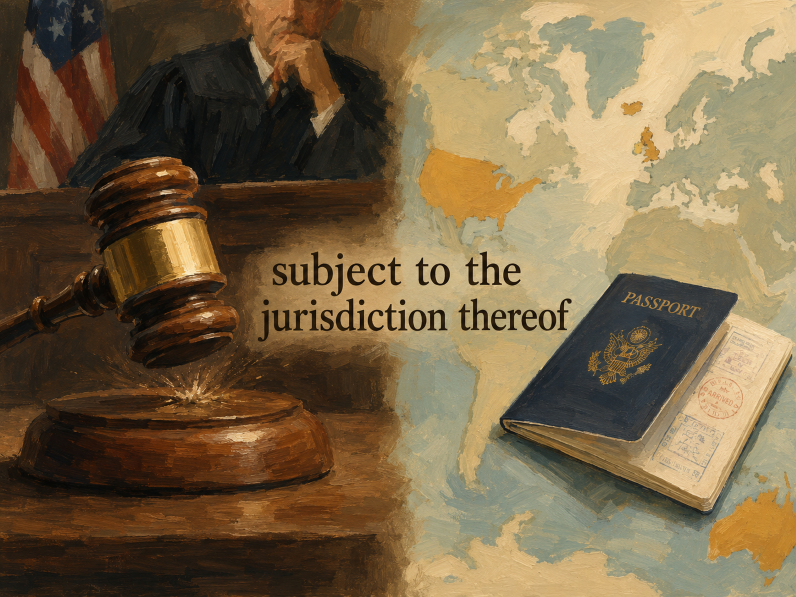
The 14th Amendment was ratified in 1868. Its Citizenship Clause reads: "All persons born or naturalized in the United States, and subject to the jurisdiction thereof, are citizens of the United States and of the State wherein they reside."
The amendment was not written to resolve a future debate about immigration. It was written to resolve an existing injustice. The people it was designed to protect — freed slaves and their children — were already present in the United States. They had been brought here against their will. They had no other country and owed allegiance to no other sovereign. The former Confederate states were simply refusing to legally recognize what was, in every practical sense, already true. The amendment's framers wrote it to end that refusal.
The operative phrase — "subject to the jurisdiction thereof" — has been disputed ever since. In 1898, the Supreme Court addressed it directly in United States v. Wong Kim Ark, holding 6-2 that the phrase means subject to U.S. law — essentially, anyone physically present on U.S. soil, with narrow exceptions for foreign diplomats and hostile occupying forces. Wong's parents had been permanently domiciled in San Francisco for over twenty years at the time of the ruling.
That decision has governed birthright citizenship for 126 years. On January 20, 2025, President Trump signed Executive Order 14160 seeking to restrict birthright citizenship to children born to at least one parent who is a U.S. citizen or lawful permanent resident. Every federal court that reviewed the order blocked it. One judge called it "blatantly unconstitutional." The Supreme Court agreed to hear the case, and oral arguments were held April 1, 2026. The Court issued its ruling on June 30, 2026.
The Evidence
The vote count
The ruling is reported as 6-3. That accurately describes who voted to strike down the executive order. It does not accurately describe the constitutional holding.
Chief Justice Roberts wrote the majority opinion, joined by Justices Sotomayor, Kagan, Barrett, and Jackson — five justices. Justice Kavanaugh voted to strike down the order but wrote separately, concurring only in the judgment. Kavanaugh's basis was statutory, not constitutional: he concluded the order violated 8 U.S.C. §1401(a), the federal statute codifying birthright citizenship, but declined to join the majority's constitutional holding. He wrote explicitly that the Constitution does not bar Congress from legislating exceptions: "Congress could — consistent with the Fourteenth Amendment — amend §1401(a) or otherwise enact new legislation establishing exceptions to birthright citizenship for children born to foreign citizens unlawfully or temporarily in the country. But Congress has not yet done so."
Justices Thomas, Gorsuch, and Alito dissented. The constitutional holding — that the 14th Amendment itself prohibits restricting birthright citizenship by executive or legislative action — rests on five justices, not six.
The dissents
Justice Thomas, joined by Gorsuch, wrote a 91-page dissent arguing that the Citizenship Clause was written for people already domiciled in the United States — people who were already here and called this country home. Thomas wrote that the majority's account of the amendment's history "is not historically accurate" and that the ruling "adds to the sad history of the Fourteenth Amendment, which was designed and understood to secure equal rights for the freed blacks but has instead been repurposed for political projects that the Reconstruction Congress did not support."
Justice Alito wrote separately. His dissent argued that the 14th Amendment "confers citizenship on only those children who, at birth, owe allegiance solely to this country." He then laid out a specific national security scenario that received almost no substantive coverage:
"Suppose the child never visited the United States while growing up and was inculcated with hatred of this country. According to the Court, that person is a citizen of the United States. He can enter and leave the country as he pleases. He can travel the world on a United States passport. Even if he plots to harm this country, he cannot be deprived of his status as a citizen, at least under current precedent."
Alito also warned the ruling "preserves a powerful incentive to enter or remain in this country illegally" and described the results as "grotesque."
The global picture
According to the Law Library of Congress, roughly 30 to 35 countries — out of nearly 200 worldwide — grant unconditional birthright citizenship. All but six are in the Americas and the Caribbean. The practice is nearly absent in Europe and Asia. It is not a global norm. It is a Western Hemisphere regional practice rooted in colonial-era immigration and settlement policy.
The trend line among developed nations has moved toward restriction. The United Kingdom ended unconditional birthright citizenship in 1983. Australia restricted it in 1986. New Zealand abolished unrestricted birthright citizenship in 2005. Ireland ended it by constitutional referendum — approved by 79 percent of voters — in 2004. India abolished jus soli in response to illegal immigration from Bangladesh. Alito noted this directly, writing that the majority's ruling saddles the United States with a standard that even the United Kingdom, where the principle originated, has since abandoned.
The 1898 domicile question
The Trump administration argued that Wong Kim Ark itself did not cleanly resolve the question being litigated in 2026. The administration's Solicitor General pointed to the repeated use of the word "domicile" throughout the 1898 opinion — Wong's parents had been permanently domiciled in San Francisco — and argued that domicile was the implicit condition underlying the holding, not background noise. Under that reading, Wong Kim Ark established birthright citizenship for children of permanently domiciled parents, not for children of parents with no permanent ties to the country.
Roberts rejected that argument in the majority opinion, holding that domicile was simply an uncontested fact in the 1898 case and that the historical record showed "no evidence that the ratifiers of the Fourteenth Amendment thought themselves to be imposing a domicile limitation." The majority opinion acknowledged that the dissent in Wong Kim Ark — which argued for a domicile or allegiance-based reading — made "the strongest case for a domicile-based theory of American citizenship." That dissent lost in 1898. It lost again in 2026.
The Analysis
The coverage that followed the ruling collapsed a genuinely complex constitutional dispute into a clean narrative: the administration pursued a frivolous argument, lost decisively, and the matter is settled. Each of those claims requires qualification.
The argument was not frivolous. Three sitting Supreme Court justices held that the majority's reading of the 14th Amendment's history is incorrect. The intellectual foundation of the administration's position — that "subject to the jurisdiction thereof" requires complete political allegiance, not mere physical presence — traces directly to Chief Justice Fuller's dissent in Wong Kim Ark in 1898. It has been the losing side of that argument for 126 years. But a position held by three current Supreme Court justices and rooted in a serious originalist reading of the amendment's purpose and history is not, by any reasonable definition, without legal merit.
The loss was not as decisive as reported. The constitutional holding rests on five justices. Kavanaugh's concurrence explicitly identifies a legislative route that Congress could pursue without a constitutional amendment. Trump read that opening immediately and publicly called on Congress to act. Whether a future congressional statute restricting birthright citizenship would survive judicial review is an open legal question — one that Kavanaugh's concurrence left deliberately unresolved.
The historical context the coverage omitted changes the reader's understanding. The 14th Amendment was written for people who were already here — people with no other country, no divided allegiance, and no alternative sovereign to claim them. The amendment solved an existing injustice, not a future immigration question. That historical fact does not resolve the constitutional dispute, but it is directly relevant to understanding what the framers were addressing when they wrote "subject to the jurisdiction thereof" — and it was almost entirely absent from coverage of the ruling.
Alito's national security argument was treated as rhetorical flourish. It is a concrete legal and policy concern: a child born on U.S. soil to a citizen of a hostile nation, raised in that nation with no connection to or allegiance toward the United States, holds an irrevocable U.S. passport and the full constitutional rights of citizenship. That is not a hypothetical invented to inflame — it is a direct legal consequence of the majority's holding, described by a sitting Supreme Court justice in a published dissent.
Counterpoints
The majority's position rests on substantial ground, and it should be stated plainly.
Roberts traced the principle of birthright citizenship from English common law through the colonial era, the founding period, and the congressional debates preceding the 14th Amendment's ratification. He found an unbroken line of legal understanding that citizenship attaches to birth on U.S. soil. He also pointed to the congressional floor debates, in which Senator Lyman Trumbull — one of the amendment's principal authors — indicated that anyone subject to U.S. law would be covered by the clause.
Roberts further addressed the domicile argument directly, holding that no evidence in the historical record suggests the ratifiers intended to impose a domicile requirement. He noted that introducing a domicile standard would have created significant practical uncertainty, since domicile "is sometimes a matter of great difficulty to decide" and often depends on individual circumstances. If Congress had intended to hinge citizenship on domicile, Roberts argued, there would have been at least some discussion of it in the legislative record. There was not.
The majority's reading has also governed American life and law for 126 years. Tens of millions of citizens hold their citizenship under that understanding. That institutional weight is not itself a constitutional argument, but it is a legitimate consideration in evaluating the costs of departure from settled precedent.
Where the counterpoint is weakest: the majority did not fully resolve the tension between the amendment's targeted historical purpose and the breadth of its textual application. Roberts acknowledged the amendment was ratified to repudiate Dred Scott and extend citizenship to freed slaves. He did not squarely address the argument that the amendment was designed for people already here with no other country — rather than establishing a prospective rule for future birth on U.S. soil regardless of parental connection to the country.
Media Coverage / Public Narrative
The dominant framing across outlets described the ruling as a "decisive," "sweeping," or near-unanimous rebuke of the administration's position. Several early reports used the word "unanimous." The ruling was 6-3 on the outcome. It was 5-4 on the constitutional question. No outlet that used the word "unanimous" was reporting accurately.
The practical consequence of that framing is that readers came away believing the constitutional debate is closed. It is not. Kavanaugh's concurrence — written by a member of the majority — explicitly leaves open the question of whether Congress could legislate restrictions on birthright citizenship consistent with the 14th Amendment. That concurrence is the fifth vote in the majority. Its legislative road map went largely unreported.
Alito's national security argument received brief mentions in conservative outlets and was ignored or dismissed in most mainstream coverage. The global context — that unconditional birthright citizenship is the practice of roughly 30 to 35 countries out of nearly 200, and that the trend among developed nations has been to restrict it — did not appear in most coverage at all.
The framing that the administration's position was legally meritless is contradicted by the published opinions of three sitting Supreme Court justices. Coverage that characterized the position as frivolous while omitting that context was not inaccurate in reporting the outcome. It was incomplete in representing the legal landscape.
Conclusion
The Supreme Court's ruling in Trump v. Barbara is real and consequential. The executive order was struck down. The constitutional principle of birthright citizenship, as interpreted since 1898, was reaffirmed. Those facts are not in dispute.
What the coverage failed to convey is equally important. The constitutional holding rests on five justices, not six. A member of that majority identified a legislative path forward and noted Congress had not yet taken it. Three justices — in serious, lengthy opinions — held that the majority's reading of the 14th Amendment's history is wrong, and that the amendment was designed for people already present in the United States with no other country, not as a prospective rule for future births regardless of parental connection to this nation.
The amendment was written to solve a specific injustice — the refusal of the post-Civil War South to recognize the citizenship of people who were already American in every meaningful sense. "Subject to the jurisdiction thereof" was written to capture complete allegiance — the kind that freed slaves had and foreign diplomats did not. Whether that historical purpose limits the clause's application to people with permanent ties to the United States is the question the Court has now answered twice, 126 years apart, with the same result each time. That the dissenting position keeps returning — and now carries three current justices — is not evidence the debate was frivolous. It is evidence the question is harder than the headlines suggest.
Sources
About the Author
Don Keyhoetea
Don Keyhoetea writes for Rebuke Nation, an independent publication focused on media analysis, political framing, and source-based accountability.
Never miss a critique.
Subscribe to our RSS feed and get every new fact-check and media analysis delivered directly to your reader — no algorithm, no noise.