
"That's Not What He Said" — Actually, It Kind of Was
By Don Keyhoetea · June 17, 2026 · 7 min read
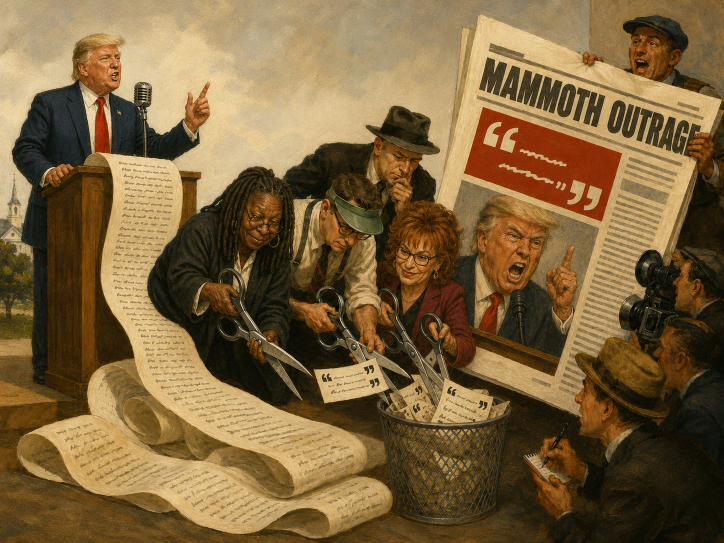
‘The View’ hosts press Vance over Trump ‘I love inflation’ comment: ‘Are you his interpreter?’
The Quick Rebuke
THE HILL'S COVERAGE
Needs ContextReaders of this article walked away thinking Vance got exposed and Trump's inflation comment was indefensible. What the full record shows is more complicated: Trump communicated poorly, Vance offered a paraphrase that tracks with Trump's own later clarification, the hosts challenged the wording without engaging the substance, and the 4.2% CPI number driving the whole segment was a war-driven energy spike interrupting a ten-year trend toward normal inflation — not evidence of a runaway economy. Inflation number, given the affordability crisis, deserves scrutiny, but the media needs the full context. Readers deserved the full quote, the New York Post clarification, the core-versus-headline CPI distinction, and the ten-year inflation trend. They got a TV recap scored by the home team.
The Hill's Main Claim
What They Got Right
The article correctly quotes all parties — Vance, Goldberg, and Behar — without apparent distortion. It accurately reports the May CPI figure of 4.2% and attributes it to the Labor Department. It notes Trump made the original comment in the Oval Office when asked about inflation numbers. It also includes Vance's defense of the "hoax" comment and his acknowledgment that gas prices remain too high, which is fair to his actual position. Inflation is a problem and given the affordability problem, it needs scrutiny.
What Needs Context
The article omitted the opening sentence of Trump's quote — the one that reframes everything.
The article quotes Trump saying "No, I love it. The numbers were great." before the infamous line, then buries it near the bottom with no analysis. That opening sentence is the most important part of the quote and reframes everything that follows. "No" is a direct rejection of the reporter's negative premise. "The numbers were great" indicates Trump was reacting to the CPI report coming in at or below expectations — not endorsing high prices as policy. The article presents the exchange as though "I love the inflation" was an unprompted declaration, when in context it was a garbled attempt to express satisfaction with a data point and confidence in a post-war trajectory.
"Three-year high" is technically accurate but hides what actually drove the number.
The 4.2% "three-year high" framing needed unpacking. Energy costs drove the headline number, jumping 23.5% year-over-year in May, with gasoline up 40.5% and fuel oil up 58.9% — driven by the conflict with Iran. Core inflation, which strips out food and energy, came in at an estimated 2.9%. Calling 4.2% a three-year high without noting it is an energy-war spike landing on an otherwise normalized inflation environment gives readers an incomplete picture of what Trump was actually looking at when he made the comment.
The decade-long inflation trend shows the current spike is an interruption, not a continuation.
The broader ten-year inflation picture is essential context the article ignores entirely. Annual CPI rates from BLS data tell a clear story: 0.1% in 2015, 1.3% in 2016, 2.1% in 2017, 2.4% in 2018, 1.8% in 2019, 1.2% in 2020. Then the COVID-era fiscal intervention broke the pattern: 4.7% in 2021, 8.0% in 2022 — the peak — followed by 4.1% in 2023 and 2.95% in 2024. The average inflation rate for 2025 was 2.6%. By February 2026 it had fallen to 2.41% — nearly back to the pre-COVID baseline — before the Iran war drove it sharply higher. That is not an inflation trend. That is a ten-year trend toward normalization interrupted by a discrete external shock. Readers of The Hill's article have no way of knowing that because the article provides none of it.
Missing Facts
The full Trump quote was publicly available and partially omitted. The complete sequence from the June 10 Oval Office briefing was: "No, I love it. The numbers were great. You know what I really love? I love the inflation. You know why? Because as soon as this war is over... it's going to come down like a rock." The article quotes the paraphrase Vance offered but never presents the full original quote so readers can evaluate for themselves whether Vance's version was fair. Trump also separately told the New York Post: "The numbers are going to be phenomenal because what's showing is that despite the fact that we're in a war, the numbers are much lower than anticipated, and when we're out of that war, the numbers will be at lower numbers than they were even before it started." That clarification from the president himself — which substantially aligns with what Vance told The View — is absent entirely.
On the "hoax" exchange: Trump's original December 2025 Pennsylvania speech shows he called "affordability" a Democrat hoax, then immediately contradicted himself in the same speech, saying "I can't say 'affordability hoax' because I agree the prices were too high." Vance's narrower defense on The View — that Republicans causing the problem is the hoax — is actually a more coherent position than what Trump originally said. Neither the article nor the hosts explored that distinction.
Our Analysis
The Hill treated a TV exchange as a credibility contest and scored it for the hosts without checking who was right.
The Hill's framing treats The View exchange as a credibility contest and scores it in favor of the hosts without doing the work to determine who was actually correct. That's a significant editorial failure dressed up as political coverage.
Behar's "interpreter" line is rhetorically effective and logically empty.
Behar's "are you his interpreter?" line played well in the studio, but it's hollow under examination. Vice presidents contextualize and defend presidential statements as a core function of the role. Every administration sends surrogates to do exactly that. The line doesn't challenge Vance's explanation — it challenges his standing to give one, which is not the same thing. No outlet applying that standard to Vance would apply it to a Democratic vice president defending a misread presidential quote. The Hill treated it as a punchline that landed when it was actually a dodge.
Goldberg's challenge was the stronger one — but she didn't finish the argument.
Whoopi's "that's not what he said" has a kernel of truth — Vance did restructure the quote into a tighter causal sentence Trump never literally delivered in that form. But Goldberg doesn't complete the argument. She asserts the explanation is wrong without demonstrating it. The full quote, Trump's own New York Post clarification, and the CPI data context were all available and would have given the exchange actual substance. Instead the article ends on Behar's one-liner as though it settled something.
The decade of inflation data fundamentally changes the story The Hill told.
The CPI framing compounds the problem. "Three-year high" implies a worsening trend under the current administration. But inflation had been trending down — sharply and consistently — from the 2022 peak of 8% all the way to 2.41% in February 2026, nearly returning to the pre-COVID baseline of roughly 1.5–2.4% that defined the 2015–2019 period. The current 4.2% is not a continuation of that high-inflation era. It's a war-energy shock interrupting an otherwise resolved inflation problem. That context doesn't let Trump off the hook for the Iran war or his communication failures, but it's directly relevant to whether his read of the May CPI numbers was as detached from reality as the segment implied. The Hill chose not to provide it.
The Bottom Line
Readers of this article walked away thinking Vance got exposed and Trump's inflation comment was indefensible. What the full record shows is more complicated: Trump communicated poorly, Vance offered a paraphrase that tracks with Trump's own later clarification, the hosts challenged the wording without engaging the substance, and the 4.2% CPI number driving the whole segment was a war-driven energy spike interrupting a ten-year trend toward normal inflation — not evidence of a runaway economy. Inflation number, given the affordability crisis, deserves scrutiny, but the media needs the full context. Readers deserved the full quote, the New York Post clarification, the core-versus-headline CPI distinction, and the ten-year inflation trend. They got a TV recap scored by the home team.
Sources
About the Author
Don Keyhoetea
Don Keyhoetea writes for Rebuke Nation, an independent publication focused on media analysis, political framing, and source-based accountability.
Never miss a critique.
Subscribe to our RSS feed and get every new fact-check and media analysis delivered directly to your reader — no algorithm, no noise.