
Silence Is a Choice: How the UK Media Buried the Rape Gang Report
By Don Keyhoetea · June 19, 2026 · 15 min read
Bottom Line
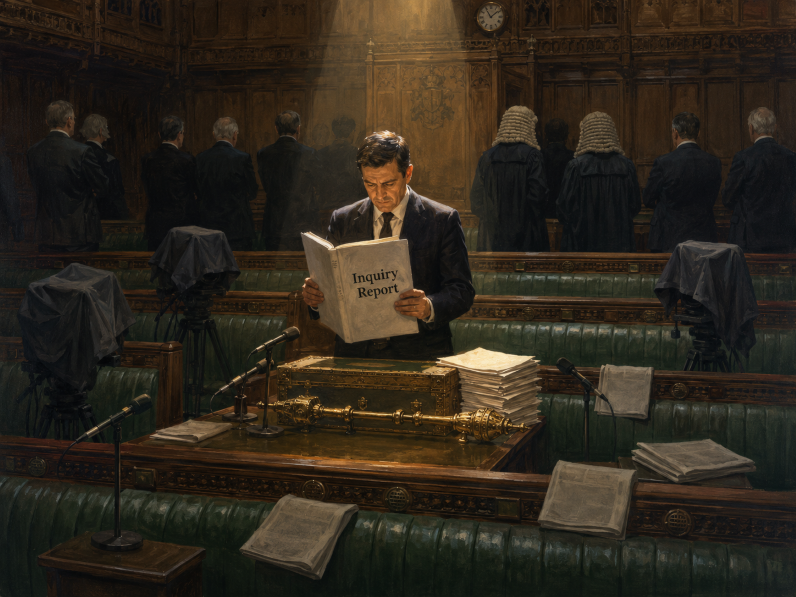
Readers deserved to know that a sitting British MP released the most comprehensive independent investigation into organized child rape in UK history, that it implicated the police forces, prosecutors, councils, NHS services, and the political party currently governing the country, and that the national broadcaster funded by public licence fees — the same broadcaster that devoted live coverage and prime-time programming to a government-commissioned audit covering the same crimes — chose to publish nothing. They deserved to know that the Prime Minister who now oversees the statutory inquiry ran the Crown Prosecution Service while it decided rape victims were not credible witnesses, whipped his entire parliamentary majority to vote down accountability, called everyone demanding that accountability a far-right agitator, and reversed course only when the political cost of silence became too high. And they deserved to know that the institutions now being asked to investigate and correct these failures are the same institutions the report documents as having driven them — which is precisely why a crowdfunded citizens' inquiry led by a survivor existed in the first place, and precisely why the press that ignored it should be held to account for that choice.
Background & Context
This should be a huge story. The Media is choosing to be silent, because they are afraid of offending Muslim people. This is not about offending anyone. Facts are facts. Our Women and children across the world deserve better than this.
The Analysis
What the Report Is
The Rape Gang Inquiry Report is the most comprehensive citizen-led investigation into organized child sexual exploitation ever conducted in Britain.
Released June 16, 2026, the Rape Gang Inquiry Report is a 219-page document produced by a survivor-led inquiry chaired by MP Rupert Lowe and led on the ground by Sammy Woodhouse — a survivor turned activist. It was funded by over 20,000 members of the British public who contributed more than £600,000. The inquiry held no statutory powers, meaning it could not compel witnesses or seize evidence. What it had instead was something the government's own inquiries repeatedly lacked: people willing to tell the truth on the record.
The report's geographic scope alone should have made it front-page news across every outlet in the country.
The inquiry drew on court records, previous official and unofficial inquiries, survivor testimony, whistleblower accounts, and expert evidence to conclude that organized rape gang networks operated in at least 149 local authority districts — nearly 40 percent of every municipality in England, Scotland, Wales, and Northern Ireland. Almost 19,000 young girls and women in England were identified as victims of sexual exploitation in a single year alone. The report estimates at least 250,000 victims since the 1950s, a figure derived from documented local data in towns like Rotherham and Telford and extrapolated nationally — and one the report itself notes is a bare minimum given the decades-long institutional failure to record offender ethnicity or victim numbers at a national level.
The perpetrator profile documented in the report is unambiguous and consistent with every prior official inquiry.
According to the report, 87 to 95 percent of identified abusers bore distinctively Muslim names, predominantly of Pakistani heritage, with smaller networks of Somali, Iranian, Syrian, Turkish, and other Muslim backgrounds also documented. The grooming method was consistent across locations: young girls, often aged 11 to 16, were targeted at school gates, care homes, and town centres, befriended by young Muslim men, plied with alcohol and drugs, then transported in taxis to houses, hotels, and restaurants where they were gang raped repeatedly. Many were trafficked between cities. Some were taken to Pakistan. Some were impregnated as children. Some were coerced into abortions. Some were recorded during abuse for the purpose of blackmail.
The report's appendices are a permanent public record that no future government can erase.
The 219 pages include four appendices: non-hearing victim testimony, direct survivor quotations, a full institutional failures catalogue, and a list of every area in the United Kingdom where rape gangs are known to have operated. Lowe has since stated his intention to use parliamentary privilege to name perpetrators and their enablers on the floor of the House of Commons, working with legal counsel to ensure no future prosecutions are compromised.
The full report is available at: https://static1.squarespace.com/static/6810978a41bbc42489eafa81/t/6a314bb1151e511944bd4421/1781615537601/The+Rape+Gang+Inquiry+Report.pdf
An interactive companion site mapping all 149 districts is available at: https://rapeganginquiry.co.uk/
What the Police and Prosecutors Did
Police forces across England did not fail these children by accident. They failed them by choice.
The Lowe report documents in specific terms what police forces across England and Wales did when presented with evidence of industrial-scale child rape. They ignored reports. They criminalized victims instead of perpetrators. They destroyed evidence. They allowed known rapists to walk free on bail. Whistleblower Sara Rowbotham, who worked on the front lines in Rochdale compiling names and addresses of suspected abusers and handing them directly to Greater Manchester Police and Rochdale Council, later described the experience as "disgusting" — her team were "disbelieved, scrutinized, misrepresented, scapegoated and then publicly and nationally discredited." Former detective and child sex abuse campaigner Maggie Oliver, who also worked inside GMP during this period, stated plainly that the "failures that happened then are still happening now."
The government's own review confirmed children were being blamed for their own rape.
The Independent Inquiry into Child Sexual Abuse — the government's own statutory body — found that child victims, including one who reported being held at gunpoint while 23 men sexually assaulted her, were often blamed by authorities for the ordeals they suffered. Some were issued criminal records for offences directly connected to their exploitation. The IICSA found "extensive failures" in how authorities across England and Wales tackled grooming gangs, with police councils actively denying the scale of the problem despite evidence to the contrary.
Prosecutors downgraded rape charges on children because they decided the children were in love with their attackers.
Baroness Casey's own audit — the government-commissioned review that preceded the statutory inquiry — concluded that too many grooming cases were dropped or downgraded from rape to lesser charges because prosecutors decided that a 13- to 15-year-old appeared to be "in love with" or to have "consented to" sex with the perpetrator. This is the Crown Prosecution Service concluding, on behalf of the British state, that a child cannot be raped by the adult man controlling her. That framing was not incidental. It was policy.
Operation Beaconport is now confirming the police failure is even worse than previously documented.
Operation Beaconport — the National Crime Agency's national review launched in response to Baroness Casey's recommendations — has already received 1,273 case referrals from 23 police forces, 236 of which involve allegations of rape. In the first wave of reviews, the NCA's deputy director of investigations Nigel Leary confirmed that investigators found cases where "lines of inquiry being identified but not followed, victim accounts not being taken in a way we would recognize as best practice, and suspects not being pursued or interviewed in the ways we would anticipate." Closed cases from eight force areas have already been directed to reopen. The NCA's euphemism for what happened is "human error." The more accurate description is: children reported being raped, police documented it, and then chose not to pursue the people responsible.
Keir Starmer — A Record That Demands Accountability
Starmer ran the Crown Prosecution Service during the years its prosecutors were deciding child rape victims were not credible witnesses.
Keir Starmer served as Director of Public Prosecutions — the head of the Crown Prosecution Service — from 2008 to 2013. These are the years in which the CPS's handling of grooming gang cases has been most heavily documented and most heavily criticized. The Rochdale case is the anchor. A teenage girl, referred to publicly as Girl A, disclosed to Greater Manchester Police in 2008 that she had been systematically abused and raped by a group of men. DNA evidence from her underwear linked at least one suspect directly to the crime. The CPS reviewed the case and decided she would not be viewed as a credible witness by a jury. The case was dropped. The investigation ended. The abuse continued.
The CPS under Starmer did not just fail to prosecute — it treated at least one victim as a criminal.
A 173-page review covering the period 2004 to 2013 found that one victim was treated by the CPS as a co-conspirator — specifically for "procuring children on behalf of the men who were abusing her." That is the institution Starmer led, reaching the conclusion that a child being exploited by a trafficking network was herself criminally responsible for the network's operation. As one analysis put it directly: Starmer admitted that the CPS under his leadership dropped a case against a rape gang despite overwhelming evidence of guilt. Following that decision, Greater Manchester Police ended its wider investigation into grooming gangs, and the abuse continued.
Starmer's defenders note he was not personally briefed on the Rochdale case. His critics note that does not end the inquiry.
The standard defence of Starmer's CPS record is that he was nine months into the role when the Rochdale decision was made, and no evidence exists that he was personally briefed on the specifics at the time. This is accurate. It is also insufficient. Starmer spent five years as DPP. He has claimed throughout his political career that he tackled the grooming gang scandal "head on" and that he "brought the first major prosecution of an Asian grooming gang." If he takes credit for the CPS's successes during those five years, he answers for its failures. That is not a political attack. That is accountability.
As Prime Minister, Starmer whipped 350 of his own MPs to vote against a national inquiry — then skipped the vote himself.
In January 2025, the Conservative Party tabled an amendment to the Children's Wellbeing and Schools Bill calling for a national statutory inquiry into grooming gangs. Starmer ordered his MPs to vote it down. Three hundred and fifty Labour MPs complied. The amendment was defeated 364 votes to 111. Not a single Labour MP voted for it. Starmer himself did not vote — he vocally opposed the amendment and then was absent for the division. Kemi Badenoch's challenge to Labour members representing Telford, Rochdale, Rotherham, Oldham, Bradford, and every other town where these crimes occurred — asking how they would explain to their constituents that following the Prime Minister's whip was more important than accountability — went unanswered.
When confronted publicly, Starmer called the victims' advocates the far right.
Starmer's response to mounting public pressure was to accuse those demanding accountability of "spreading lies and misinformation," of "jumping on a bandwagon" with the far right, and of being "not interested in victims." He said this while ordering his parliamentary majority to vote down a national inquiry. He said it while his safeguarding minister Jess Phillips — who had personally rejected Oldham Council's request for a government-led inquiry — was drawing calls for resignation from the survivors sitting on the inquiry's own victims liaison panel. Phillips later told Sky News "nothing is off the table," then the government's spokesperson walked that back, then Starmer flew to the G7 in Canada and announced he would accept Baroness Casey's recommendation for a full statutory inquiry. He had spent six months calling people who wanted exactly that outcome far-right agitators.
The U-turn was not leadership. It was the absence of it.
Starmer's own Rochdale Labour MP Paul Waugh, who had advocated for a national inquiry while voting against it in January, was unsparing: "Just like he dismissed concerns about the winter fuel payment and then had to U-turn, just like he needed the Supreme Court to tell him what a woman is, he had to be led by the nose to make this correct decision here." That assessment came from within his own party. The statutory inquiry Baroness Anne Longfield now chairs formally began work on April 13, 2026. It has a budget of £65 million and a three-year mandate. It exists because public pressure made silence politically untenable. It does not exist because Keir Starmer decided children deserved justice.
The BBC's silence on the Lowe report is not a news judgment. It is an editorial position with consequences.
Start with what the BBC did cover. When Baroness Casey's government-commissioned audit was published in June 2025, the BBC deployed its full apparatus. Live blogs across multiple pages. Survivors on Newsnight in a special edition. Baroness Casey interviewed on air, describing herself as "blisteringly angry." The Home Secretary's Commons statement covered in real time. BBC Verify fact-checking Starmer's personal record as DPP. BBC Breakfast hosting the shadow home secretary. Multiple correspondents filing across the day. That is what the BBC looks like when it decides a grooming gang story is a story.
Then a sitting MP released a 219-page report on the floor of the House of Commons, read survivor testimony into the parliamentary record, and the BBC published nothing.
Rupert Lowe is not a blogger. He is not a fringe activist. He is a Member of Parliament who raised £600,000 from over 20,000 British citizens, conducted 18 months of hearings with survivors, whistleblowers, parents, and experts, produced a 219-page document with four appendices, introduced an Early Day Motion to the House of Commons, and announced his intention to use parliamentary privilege to name perpetrators on the floor of Parliament. The report accumulated tens of millions of views in 72 hours. Lowe's own assessment from his X account — "Complete silence from the BBC on our rape gang inquiry report. A truly despicable organization" — is not hyperbole. It is a verifiable statement of fact.
The editorial distinction the BBC is making reveals exactly what its editors consider a legitimate source of information about child rape.
The BBC covered Casey because Casey was government-commissioned. The report arrived with institutional credibility pre-attached — a peer of the realm, appointed by the Home Secretary, backed by the state. The Lowe report arrived from the opposite direction: crowdfunded by ordinary citizens, led by a survivor, chaired by an MP who has repeatedly and publicly named the Labour Party as bearing primary political responsibility for the decades of cover-up. The BBC's silence is not about source quality. The Lowe report draws on court records, official inquiry findings, and survivor testimony that overlaps substantially with material the BBC has already reported. The silence is about who commissioned it and what its conclusions implicate.
Every major mainstream UK outlet that ignored this report made the same calculation the institutions in the report made: that naming the truth about who was doing this and who enabled it carried a cost they were not willing to pay.
The pattern documented in the Lowe report — police declining to investigate, prosecutors deciding victims were not credible, councils burying reports, NHS staff discharging children back to their abusers — was driven by a single documented institutional fear: the accusation of racism. Baroness Casey's own audit confirmed that the ethnicity of perpetrators was "shied away from" for years by the agencies responsible for protecting children. When the BBC declines to cover a 219-page report documenting that same ethnic pattern in specific detail, sourced to court records and survivor testimony, it is making the same calculation those institutions made. The children pay the same price.
The BBC covered "human error" at the NCA. It covered Baroness Casey warning survivors are "still being failed." It did not cover the report that documents in granular detail exactly how and by whom they were failed.
This is the precise editorial contradiction that condemns the BBC's news judgment. The BBC published a piece on Operation Beaconport finding that closed rape gang cases were dropped due to what investigators described as "potentially human error." It covered Casey warning that grooming survivors are still being failed. It ran Newsnight specials on survivor testimony. It engaged with every version of this story that arrived packaged in institutional language from an approved government source. The Lowe report is the same story. It is the same victims, the same perpetrators, the same institutional failures, the same towns. The only difference is who is telling it and what they are willing to call it.
Calling this a news judgment is charitable. Calling it editorial cowardice is accurate.
The BBC is funded by a licence fee extracted from every household in the United Kingdom. Among those households are the families of the 250,000 girls documented in the Lowe report. Those families funded the BBC's Newsnight specials and its Casey live blogs and its BBC Verify fact checks. They are also funding an institution that looked at a 219-page report documenting the worst sustained institutional failure in modern British history, watched it reach tens of millions of people in 72 hours, heard a Member of Parliament read the testimony of gang rape survivors into the parliamentary record — and decided it did not meet the threshold for a single article.
Sources
- 1. Full report PDF:
- 2. Interactive district map companion site:
- 3. European Conservative — report summary
- 4. GB News — report release
- 5. Parliament Early Day Motion
- 6. Western Standard — mainstream media silence
- 7. Free Speech Backlash — BBC subdued coverage assessment
- 8. GB News — CPS failure under Starmer, Rochdale timeline
- 9. GB News — Starmer questions to answer
About the Author
Don Keyhoetea
Don Keyhoetea writes for Rebuke Nation, an independent publication focused on media analysis, political framing, and source-based accountability.
Never miss a critique.
Subscribe to our RSS feed and get every new fact-check and media analysis delivered directly to your reader — no algorithm, no noise.