
MSNBC Called the Iran Deal Spin Incoherent — Then Got the Facts Wrong
By Don Keyhoetea · June 18, 2026 · 8 min read
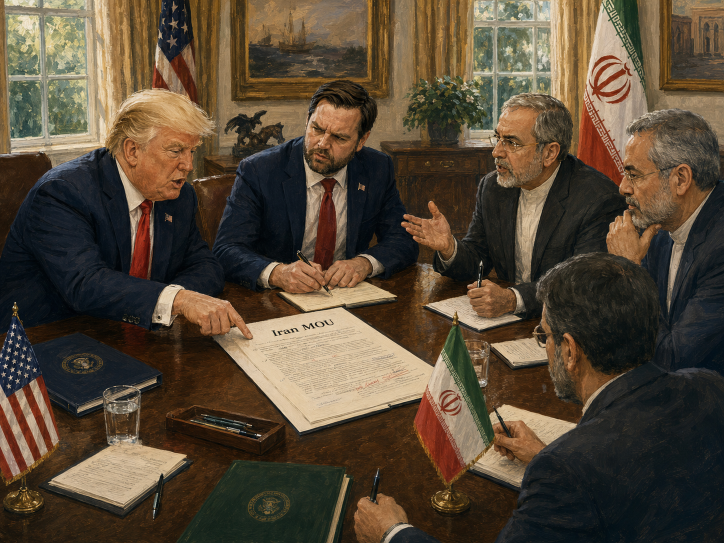
Trump and Vance’s spin on the Iran agreement is completely incoherent
The Quick Rebuke
MSNBC'S COVERAGE
Needs ContextCohen's frustration with the White House spin is understandable, and some of his specific criticisms — the proxy gap, the Strait framing, the signed document claim — are accurate. But he undermines his own credibility by misreading the $300 billion planning commitment as a payment, applying a missile standard to Trump's deal that Obama's deal also failed, and presenting JCPOA verification as a success story while stopping the timeline before the outcome that proves it wasn't. Readers deserved a critique that was as rigorous about its own evidence as it demanded the White House be about theirs. At the end of the day, We won't know the finer details until later. Hopefully the White House has a plan for these gaps.
MSNBC's Main Claim
What They Got Right
The Strait of Hormuz argument is the piece's strongest factual point.
Before the conflict began, the Strait of Hormuz was open and operating without tolls. The MOU restoring that status quo is not a strategic gain — it is a return to baseline. Cohen is correct on this and the White House talking point claiming it as a victory is difficult to defend.
The proxy support omission is real and documented.
The Trump administration had previously demanded Iran cut off support for Hezbollah, Hamas, and the Houthis as part of a broader 15-point framework. None of that made it into the signed MOU. Cohen is correct that the document is silent on Iran's ongoing support for proxy groups beyond a ceasefire reference covering Lebanon.
The missile program omission is accurate as a narrow factual claim.
The MOU does not address Iran's ballistic missile program. Cohen is factually correct on that point.
The JCPOA comparison on signed documents is accurate.
Cohen is right that Obama did receive a signed agreement — the JCPOA was a formal, multi-party document. The White House talking point claiming "Obama never even got a signed document" is false on its face.
What Needs Context
The $300 billion figure is a planning commitment, not a payment authorization.
Cohen writes that "the US and regional partners are committing to the creation of a definitive, mutually agreed plan with at least $300 billion for the reconstruction and economic development of Iran" and uses that sentence to rebut the White House claim that no taxpayer money goes to Iran. But the MOU commits the United States to develop a plan — it does not disburse funds, authorize a transfer, or write a check. A planning commitment and a payment are not the same legal or financial instrument. Using the planning language to imply US taxpayer money is flowing to Iran adds a claim the text does not support.
The fund is conditional and not yet operational.
The $300 billion reconstruction fund does not exist yet and cannot become operational until a final deal is signed. Iran must permanently end its nuclear program, surrender its enriched uranium stockpile, allow inspections, and demonstrate sustained compliance through a 60-day negotiation window. Cohen presents the fund as an established financial concession without acknowledging those conditions, which leaves readers with the impression the money is already agreed upon and on its way.
The missile omission critique applies equally to the JCPOA.
Cohen criticizes the MOU for failing to address Iran's ballistic missile program. That is a legitimate concern. But the JCPOA made the same omission — deliberately. The US and other P5+1 nations agreed to exclude ballistic missiles from the 2015 negotiations because China, Russia, and Iran blocked their inclusion, and because there is no international treaty that sufficiently governs indigenous missile development. Criticizing Trump's deal for a gap that existed in Obama's deal, without disclosing that context, is a selective double standard.
Vance's statements are being collapsed into a contradiction that isn't one.
Cohen's broader framing implies the administration is contradicting itself on the $300 billion figure. But Vance's Monday CBS statement — that Iran could have access to a Gulf-funded reconstruction fund conditioned on compliance — and his Tuesday Fox and Friends statement — that not a single cent of American money goes to Iran — are answers to two different questions. One addresses whether the fund exists. The other addresses who funds it. Treating those as a contradiction requires ignoring what each statement was actually responding to.
Missing Facts
The JCPOA verification record has a second half Cohen does not mention.
Cohen writes that Iran was "adhering" to the JCPOA before Trump pulled the US out in 2018, citing that as evidence the deal's verification mechanisms worked. The IAEA did confirm Iranian compliance with nuclear-specific terms through that period. But by June 2022, several analysts assessed Iran's nuclear breakout time had reached effectively zero — meaning the time needed to produce enough fissile material for a weapon had collapsed to near nothing. That is the outcome the JCPOA's verification regime existed to prevent. Citing pre-2018 compliance without disclosing the post-2018 outcome presents half a timeline as a complete verdict.
Iran used the JCPOA itself to block inspections.
After Trump withdrew, Iran blocked IAEA access to two sites of concern and presented a tendentious interpretation of the JCPOA's December 2015 Board of Governors resolution as justification for refusing to cooperate with inspectors. The verification mechanisms Cohen cites as superior did not prevent Iran from using the deal's own legal framework to stonewall the agency investigating it.
The 24-day inspection window was a documented structural weakness.
The JCPOA replaced 24-hour inspection notice with a process that could extend to 24 days before Iran was required to grant access or face consequences. Senate Foreign Relations Committee testimony from nuclear policy experts described this as a critical flaw that undermined the IAEA's authority and set a precedent for future proliferators. Cohen presents the JCPOA verification regime as though it had no meaningful critics — it had significant ones, including voices that supported the deal's nuclear limits while opposing its inspection architecture.
Our Analysis
Cohen's piece is opinion, and opinion gets latitude — but factual claims inside opinion pieces still have to be accurate.
The article is labeled opinion, which means Cohen is entitled to argue that the deal is bad, that Trump got played, and that the White House spin is incoherent. He may be right about all of that. But he supports those arguments with factual claims that do not hold up under scrutiny, and that matters regardless of the label.
The $300 billion error is the most damaging because Cohen uses it as a rebuttal to a specific factual claim.
When Cohen cites the MOU's $300 billion language to rebut the White House talking point that "Iran's rewards come from its own frozen money, not from taxpayers," he is treating a planning commitment as proof of a cash disbursement. Those are not the same thing. The White House talking point has its own problems — it papers over real financial concessions — but Cohen's rebuttal does not actually land the punch he thinks it does, because the text he quotes does not say what he implies it says.
Holding Trump's missile omission against him while ignoring Obama's identical omission is the piece's most straightforward double standard.
This is not a close call. Ballistic missiles were excluded from the JCPOA not by accident but by agreement among the negotiating parties, over US objections, because Russia, China, and Iran refused to allow their inclusion. Cohen knows the JCPOA well enough to cite its verification provisions in detail. The missile exclusion is basic JCPOA history. Omitting it while using the missile gap to criticize Trump's deal is not an oversight — it is a framing choice that makes the Obama deal look stronger by comparison than a complete accounting would support.
The JCPOA verification argument is the piece's most consequential selective use of the record.
Cohen cites Iranian compliance through 2018 as evidence the JCPOA's verification mechanisms worked. But verification is not the goal — nonproliferation is. The relevant question is not whether Iran followed the rules while it suited them, but whether the deal prevented Iran from reaching nuclear weapons capability. By 2022, with the deal effectively dead, Iran's breakout time had collapsed to zero. Cohen presents a chapter of the story that supports his argument and stops before the chapter that complicates it.
Where Cohen is on solid ground, his critics should be honest about it.
The proxy group gap is real. The Strait of Hormuz talking point is weak. The signed document comparison is accurate. The White House is selling a deal that has significant unanswered questions as a clean victory, and Cohen is right to press on that. The problem is that legitimate criticism gets diluted when it is packaged with factual errors and selective historical framing. Readers who agree with Cohen's conclusion may not notice the gaps. Readers who disagree will use those gaps to dismiss everything else.
The Bottom Line
Cohen's frustration with the White House spin is understandable, and some of his specific criticisms — the proxy gap, the Strait framing, the signed document claim — are accurate. But he undermines his own credibility by misreading the $300 billion planning commitment as a payment, applying a missile standard to Trump's deal that Obama's deal also failed, and presenting JCPOA verification as a success story while stopping the timeline before the outcome that proves it wasn't. Readers deserved a critique that was as rigorous about its own evidence as it demanded the White House be about theirs. At the end of the day, We won't know the finer details until later. Hopefully the White House has a plan for these gaps.
Sources
About the Author
Don Keyhoetea
Don Keyhoetea writes for Rebuke Nation, an independent publication focused on media analysis, political framing, and source-based accountability.
Never miss a critique.
Subscribe to our RSS feed and get every new fact-check and media analysis delivered directly to your reader — no algorithm, no noise.