
The Iran Deal Has Had Six Breakthroughs. None of Them Held. Here's What the Press Missed.
By Don Keyhoetea · May 29, 2026 · 8 min read
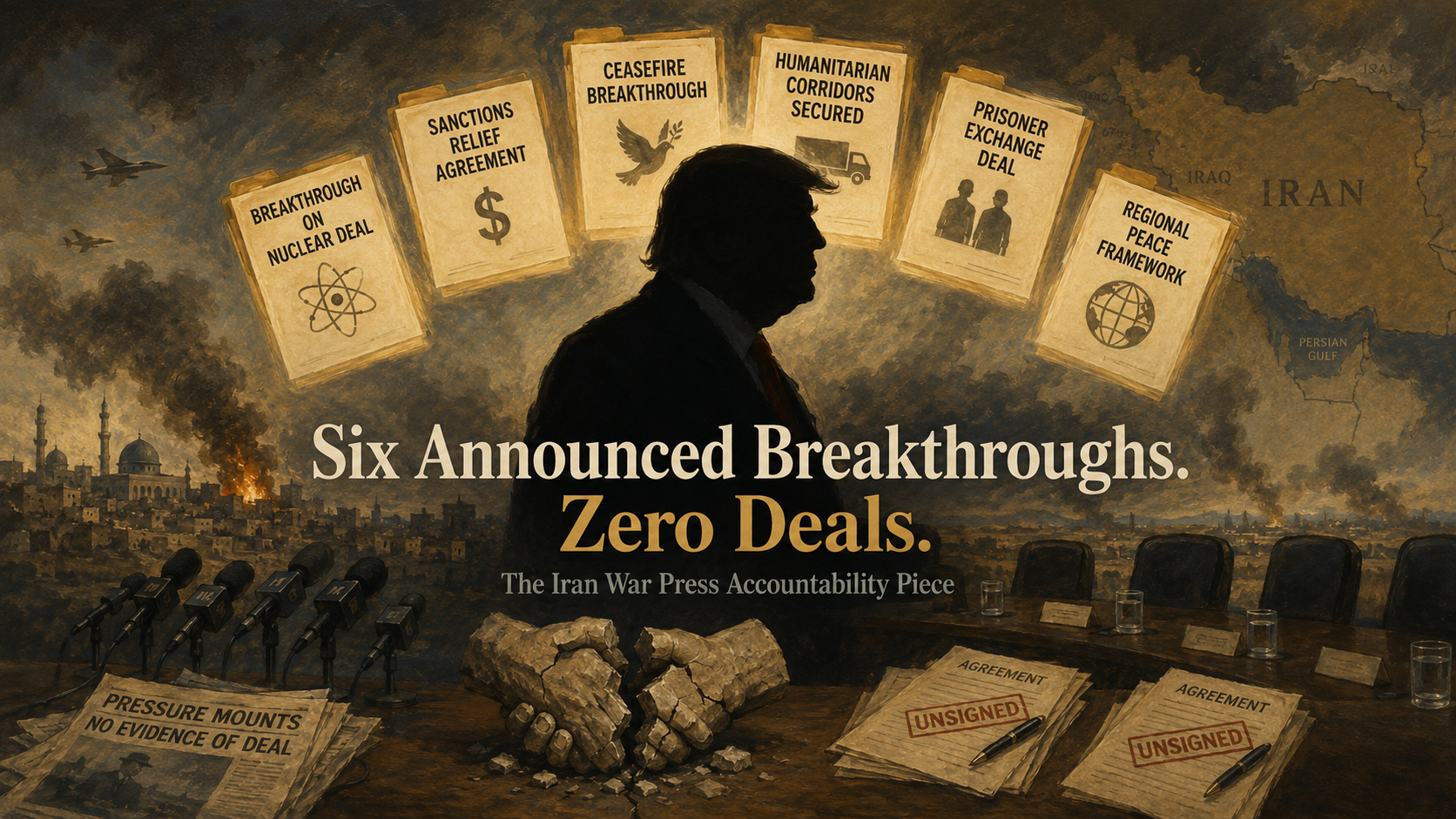
The Quick Rebuke
MEDIA COVERAGE
Opinion / AnalysisA 60-day MOU framework has been reached as of today — the most concrete diplomatic development in the Iran war since the April 8 ceasefire. It deserves serious coverage. What it also deserves, and is not getting, is the context that makes it meaningful: every previous announced breakthrough dissolved without consequence; the uranium demand Trump called non-negotiable 72 hours ago has been deferred to a 60-day window; the Accords condition he called mandatory last week is absent from every deal description today; the oversight body he named for uranium disposal does not exist; Iran's original 10-point framework already included continued Iranian control of the Strait; and the threat to resume bombing if talks fail is constrained by a munitions shortage the Pentagon has not addressed. None of those facts are secret. All of them are on the record from CNN, NPR, NBC, Al Jazeera, Bloomberg, the Council on Foreign Relations, and the House of Commons Library. The press is reporting a number — 60 days — as if the number itself means something has been resolved. Nothing has been resolved. The uranium question is deferred. The Hormuz control question is deferred. The sanctions question is deferred. The Abraham Accords condition has vanished without explanation. What the 60-day MOU actually does is give both sides a structured way to keep talking without committing to anything. That may be valuable. It is not a breakthrough. And the difference between those two things is exactly what readers deserved to know today — and were not told.
The Main Claim
What Needs Context
Since originally saying the war would be over "in a matter of days," Trump has repeatedly announced the conflict is nearing an end, only for talks to fall through. The specific sequence matters and no outlet has assembled it:
February 19 — Trump gave Iran 15 days to reach a deal or face an "unfortunate" outcome. The deadline passed. No deal.
February 28 — Trump launched the war saying it would be over "in a matter of days." It is now day 89.
March 23 — Trump said negotiations could produce results within "five days or sooner." Five days passed. No deal.
May 23 — Trump posted a deal was "largely negotiated" and would be "announced shortly." Iran's state media called it "incomplete and inconsistent with reality."
May 25 — Trump posted the deal was not "even fully negotiated yet" — walking back the "largely negotiated" claim from 48 hours earlier
May 26 — Trump said "we can make a good deal right now, but maybe not a great deal. And if it's not a great deal, we're not making it."
May 28 — A 60-day MOU framework is announced. Trump has not yet signed it.
Bloomberg noted in its own MOU coverage that "both countries have previously hailed progress, with Trump repeatedly indicating the US was close to securing an agreement — only for the stalemate to drag on." That sentence appeared in paragraph six. It should have been paragraph one.
The 60-day MOU is a window, not a resolution — and coverage is treating it as the latter.
It is unclear whether the 60-day extension represents a deadline for negotiations or simply a framework period. Details of the tentative deal remain obscure. If it is not a hard deadline, the 60-day MOU is structurally identical to the open-ended ceasefire already in place — except with a number attached. If Trump agrees to the deal it would push the thorniest details over Iran's nuclear ambitions down the road. "Down the road" is not a resolution. It is a deferral. The press is covering a deferral as a breakthrough.
Missing Facts
Trump's "immediately" uranium demand directly contradicts the MOU framework — and no outlet reconciled the two.
Trump posted on Truth Social just 72 hours before the MOU announcement that Iran's enriched uranium "will either be immediately turned over to the United States to be brought home and destroyed or destroyed in place." The MOU framework defers the uranium question entirely to the 60-day negotiating window, with talks during that period focusing on the future of Iran's enrichment program and disposal of its highly enriched uranium stockpile. "Immediately" has become "in 60 days, maybe." That is a significant public climb-down from a stated non-negotiable position announced three days earlier. No outlet asked the White House to reconcile the two statements.
Trump's uranium post contained a second problem that received almost no coverage. Trump named the "Atomic Energy Commission" as the oversight body for uranium disposal. The Atomic Energy Commission was abolished more than 50 years ago. NBC noted this in passing, suggesting Trump may have meant the IAEA. A president publicly naming a nonexistent body as the verification mechanism for a nuclear agreement is not a minor error. It is a specific signal about the level of technical preparation behind the US negotiating position.
Iran says the uranium was never part of the current deal at all.
Iran's Foreign Ministry stated that the fate of its nuclear material "has not been part of the talks" and that the focus at this stage is on ending the war. A senior Iranian diplomat confirmed that the nuclear program would be addressed only during a subsequent negotiating window, after a preliminary agreement on ending the war and releasing frozen assets. Three simultaneous claims exist on the public record — Trump says surrender uranium immediately; Iran says uranium is not part of current talks; US officials say it was already communicated privately. All three are documented. Not one outlet assembled them in a single piece and asked which is accurate.
The Abraham Accords condition vanished without explanation.
Trump announced mid-negotiation that he expected Saudi Arabia, Qatar, Pakistan, Turkey, Egypt, Jordan, and Bahrain to simultaneously sign the Abraham Accords as part of any Iran war settlement, calling it "mandatory." The MOU framework descriptions from Al Jazeera, Bloomberg, NBC, and Axios do not mention the Abraham Accords at all. Either the condition was dropped — a significant US concession — or it was never formally part of the MOU and Trump's "mandatory" language was aspirational rather than operative. The press has not asked which. A condition announced as mandatory one week ago that disappears from deal descriptions the following week is a direct accountability question about what the US negotiating position actually is. It has gone entirely unasked.
The US military's munitions problem constrains the "resume bombing" threat.
As of mid-May, the Pentagon had not signed any new contracts to replenish dangerously low levels of munitions. The entire US negotiating posture rests on the credibility of its threat to resume bombing if talks fail. If the military cannot sustain extended operations, that threat is not fully credible. This is the most structurally important fact in the entire negotiation and it appeared in one NBC piece and nowhere else.
Our Analysis
The Iran deal coverage is not dishonest. It is episodic. Each outlet is accurately reporting each development as it happens — the uranium post, the "largely negotiated" claim, the MOU framework, the Bloomberg confirmation — without assembling the cumulative record that would allow readers to evaluate any individual announcement in context.
The result is coverage that has reported at least six breakthroughs in three months without ever asking why the previous five did not produce a deal. It has reported Trump's uranium demand without noting he named a government body abolished over 50 years ago as the verification mechanism. It has reported the MOU as a tentative breakthrough without noting that "Trump approval pending" is the critical qualifier — and that the same qualifier applied to every previous announced breakthrough that then dissolved.
The Abraham Accords omission is the most revealing editorial failure. A condition Trump called "mandatory" — one that would require eight sovereign nations to normalize relations with Israel as a condition of ending a bilateral war — quietly disappeared from deal descriptions over the course of one week. No outlet flagged the disappearance. No outlet asked whether it was dropped or was never binding. In any other context, a president publicly walking back a stated non-negotiable condition would be treated as a major diplomatic story. Here it received no coverage because each outlet was reporting the current state of negotiations rather than tracking what changed from the previous state.
The original ceasefire framework context compounds the problem. The House of Commons Library — one of the most reliable nonpartisan research sources on the conflict — notes that the talks following the April 8 ceasefire have addressed freedom of navigation, Iran's nuclear and ballistic program, reconstruction, sanctions, and a long-term peace agreement. Those are five separate and interconnected negotiating tracks. Coverage that treats the uranium question as the singular sticking point while the Hormuz control question, the sanctions question, and the Abraham Accords question are all simultaneously in play gives readers an incomplete map of how complex this negotiation actually is.
The Bottom Line
A 60-day MOU framework has been reached as of today — the most concrete diplomatic development in the Iran war since the April 8 ceasefire. It deserves serious coverage. What it also deserves, and is not getting, is the context that makes it meaningful: every previous announced breakthrough dissolved without consequence; the uranium demand Trump called non-negotiable 72 hours ago has been deferred to a 60-day window; the Accords condition he called mandatory last week is absent from every deal description today; the oversight body he named for uranium disposal does not exist; Iran's original 10-point framework already included continued Iranian control of the Strait; and the threat to resume bombing if talks fail is constrained by a munitions shortage the Pentagon has not addressed. None of those facts are secret. All of them are on the record from CNN, NPR, NBC, Al Jazeera, Bloomberg, the Council on Foreign Relations, and the House of Commons Library. The press is reporting a number — 60 days — as if the number itself means something has been resolved. Nothing has been resolved. The uranium question is deferred. The Hormuz control question is deferred. The sanctions question is deferred. The Abraham Accords condition has vanished without explanation. What the 60-day MOU actually does is give both sides a structured way to keep talking without committing to anything. That may be valuable. It is not a breakthrough. And the difference between those two things is exactly what readers deserved to know today — and were not told.
Sources
- 1. Deal or no deal? Trump's social media posts add confusion to Iran conflict — NBC News, May 26, 2026
- 2. What's in the proposed deal that could end the US-Iran conflict? — CNN, May 24, 2026
- 3. US and Iran reach tentative deal for 60-day truce extension — Al Jazeera, May 28, 2026
- 4. U.S. and Iran appear to reach ceasefire deal, but Trump needs to approve — MS NOW / NBC, May 28, 2026
- 5. Trump says Iran has 15 days to reach a deal or face "unfortunate" outcome — Fox News, February 19, 2026 (15-day deadline)
- 6. Trump: Deal with Iran is 'largely negotiated' — NPR, May 23, 2026 ("largely negotiated" claim, Iran contradiction)
- 7. Trump says deal with Iran, including opening Strait of Hormuz, is 'largely negotiated' — PBS / AP, May 23, 2026 ("announced shortly" language, calls with eight regional leaders)
- 8. Trump outlines plans for Iran enriched uranium — NewsNation, May 25, 2026 (senior Iranian diplomat: nuclear issue not part of preliminary agreement; 60-day window context)
- 9. US, Iran Agree to 60-Day Truce Renewal Pending Trump Signoff — Bloomberg (MOU description contains no mention of Abraham Accords)
About the Author
Don Keyhoetea
Don Keyhoetea writes for Rebuke Nation, an independent publication focused on media analysis, political framing, and source-based accountability.
Never miss a critique.
Subscribe to our RSS feed and get every new fact-check and media analysis delivered directly to your reader — no algorithm, no noise.