
HuffPost's Embryo Story Has a Foundation Problem
By Don Keyhoetea · June 17, 2026 · 10 min read
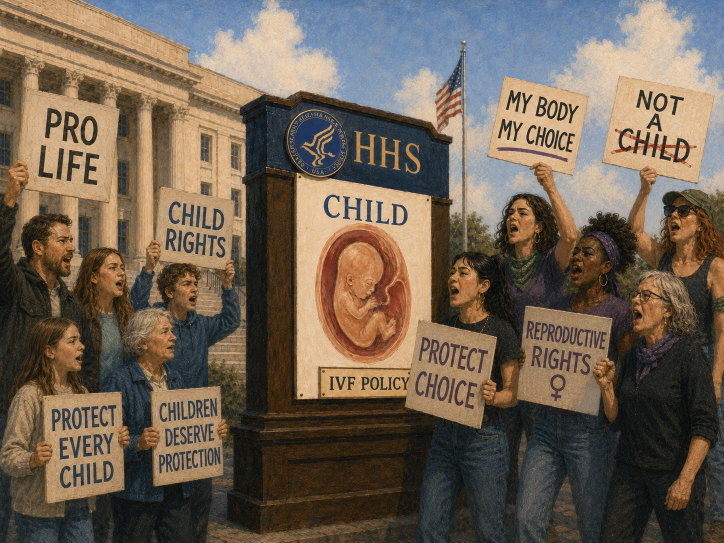
Trump Administration Quietly Redefines Embryos As Children In Obscure Grant Program
The Quick Rebuke
HUFFPOST'S COVERAGE
MisleadingReaders deserved to know that the Embryo Adoption Awareness program was built on the same ideological foundation HuffPost is now treating as a recent contamination. They deserved to know that the program's primary grantees have excluded LGBTQ+ families since before Barack Obama's first term. They deserved to know that their primary sources represent an advocacy organization with a declared position on abortion, and that the IVF threat being warned about is, by those same sources' own admission, speculative at this stage. The language change in the grant is real. What HuffPost is actually defending — without saying so — is the terminological framework that keeps embryos below the threshold of personhood, because that framework is load-bearing for the broader abortion debate. That is the story underneath this story. Readers never got to read it.
Huffpost's Main Claim
What They Got Right
The language change in the grant description is real and documented. The 2026 EAA grant NOFO (Notice of Funding Opportunity) does appear to replace "embryo" with "child" or "children" throughout the description, using phrases like "children who already exist" and "the best interests of the child" to refer to frozen embryos. HuffPost's sourcing from the National Women's Law Center on this point is direct, and the HHS press secretary's response confirms the administration's "dignity of life" framing without disputing the language shift.
The Alabama IVF comparison is accurate. The article correctly notes that Alabama IVF clinics were forced to temporarily shut down following a state Supreme Court ruling that granted frozen embryos the same legal protections as children under the state's wrongful death statute. That is well-documented and directly relevant to what is at stake in personhood debates.
The internal tension within the Trump administration over IVF is worth noting. Trump signed an executive order in February 2025 seeking policy recommendations on expanding IVF access, later negotiated an 84-percent discount on fertility drugs through the TrumpRx platform, and publicly dubbed himself the "fertilization president." That sits alongside HHS inserting personhood-adjacent language into a federal grant program. The genuine tension here is not between Trump and his own administration — as we address below — but between a personhood framework and the IVF industry's current standard practice of routine embryo disposal. That is a real friction point worth examining, even if HuffPost misidentified where it lives.
What Needs Context
The NWLC, the article's primary source, is not a neutral watchdog. The National Women's Law Center is an advocacy organization with a documented, explicit pro-abortion-rights position. HuffPost quotes their senior directors extensively and adopts their "Trojan horse" framing without disclosing the organization's advocacy mission or offering any counterweight from groups with a different view. That is not balance — it is choosing a source that agrees with your thesis and presenting their characterization as expert analysis.
The IVF threat is speculative, and the article's own sources say so. The piece buries a critical admission deep in the body: NWLC representatives said they are "not particularly concerned about the scope of the impact this revision will have on recipients of the grant." The concern is about what the language change might signal for future policy arguments — not what it does today. The headline, "Quietly Redefines Embryos As Children," implies a sweeping federal policy shift. What the article actually describes is an update to grant application language in a program that distributes under one million dollars per year.
The funding figures in the article don't match public records. HuffPost states the program "offers nearly $2 million in funding for six organizations." HHS public records show $818,000 awarded in 2024 to three organizations — not six. The article provides no explanation for how it arrived at either figure.
Missing Facts
The EAA program was pro-life by design from its founding — not by Trump's revision. This is the most significant omission in the piece. The program was not a neutral family-building awareness campaign that the Trump administration recently weaponized. According to the historical record, pro-life groups lobbied President Bush specifically to create this grant as a counter to embryonic stem cell research funding. Nightlight Christian Adoptions — a self-described pro-life organization — has received the grant every year since its 2002 inception. Christian organizations have historically dominated the recipient list. Describing the 2026 language change as a "transformation" into "a vehicle for anti-abortion rhetoric" requires readers to believe the program was something else before. It was not.
The program was never particularly welcoming to LGBTQ+ families. The article frames the grant's new emphasis on faith-based organizations as "seemingly signaling a move away from supporting LGBTQIA+ people and couples seeking to start a family" — implying LGBTQ+ families previously had meaningful access. The evidence does not support that. The largest historical recipients, including Nightlight Christian Adoptions and the National Embryo Donation Center, have required applicants to be married heterosexual couples. Faith-based organizations with traditional family definitions were not brought in by the Trump administration — they were there from the beginning.
The word "embryo" itself is not the clinical neutral term the article implies. The Greek root embryon — from which the English word derives — means "young one" or "young one in the womb." The leap from "embryo" to "child" that HuffPost presents as a radical ideological act is, etymologically speaking, a short one. A human embryo is genetically distinct from either parent from fertilization, human in species, and alive by any standard biological definition. Whether that biological reality confers the legal or moral status of "child" is a legitimate philosophical and religious debate — but the article treats one side of that debate as scientific consensus and the other as fringe ideology, without defending the premise.
Our Analysis
The program's history dismantles HuffPost's framing before the second paragraph.
The central editorial problem with this piece is that its premise — a neutral program quietly transformed by ideological actors — collapses the moment you look at the program's actual history. This was not a family-planning resource that advocates for all family structures. It was created by the Bush administration at the request of pro-life organizations, has been administered primarily by Christian adoption agencies for over two decades, and has been openly hostile to same-sex couples through many of its primary grantees. HuffPost did not report any of that. Whether through incomplete research or deliberate omission, the result is the same: readers are handed a false baseline.
The LGBTQ angle is the least defensible claim in the piece.
Framing the new grant language as a threat to LGBTQ+ families requires readers to believe those families had something to lose. By most available evidence, the dominant EAA grantees actively excluded them. Nightlight Christian Adoptions requires applicants to present as a married man and woman. The National Embryo Donation Center maintains similar requirements. These organizations received federal grant money under Democratic and Republican administrations alike. If there is a story about LGBTQ+ exclusion from federal embryo adoption funding, it is not a 2026 story — it is a 2002 story that HuffPost chose not to tell.
Calling an embryo a child does not contradict supporting IVF — it reframes the obligations around it.
HuffPost implies that personhood-adjacent language is inherently hostile to IVF. That argument does not hold up under scrutiny. There is a coherent and internally consistent position that says: IVF is a legitimate path to family formation, and the embryos created through that process deserve more careful treatment than the industry currently provides. Those two things do not contradict each other. The EAA program itself is the proof of concept — it exists specifically to find families for surplus embryos rather than have them discarded. Supporting IVF while calling embryos children is not hypocrisy. It is an argument that the fertility industry should be held to a higher standard of care for what it creates. The genuine tension here is not between Trump and his own administration. It is between a personhood framework and the IVF industry's current standard practice of routine embryo disposal. That is worth examining. HuffPost did not examine it — they used it as an alarm bell without following the logic through.
The article defends a linguistic framework without acknowledging it is doing so.
This is where the piece reveals its actual purpose. The resistance to calling an embryo a "child" is presented throughout as a medical and legal concern about IVF access and LGBTQ inclusion. Those are borrowed grievances. The real stakes are definitional, and the article's own sources accidentally say so. The word "embryo" has functioned in policy and media framing as a term that keeps the subject of abortion categorically below the threshold where the average person's moral instincts activate. It sounds clinical, biological, detached. "Child" does the opposite. It is the one word in the English language that carries universal protective weight — culturally, emotionally, and legally — without requiring any philosophical argument to make it land. You do not need a theology degree to react to the word "child." That reaction is the point, and it is precisely why the abortion-rights movement has spent decades carefully maintaining terminology — embryo, fetus, clump of cells, products of conception — in public discourse and policy documents. These are not neutral scientific choices. They are definitional gatekeeping.
The NWLC sources buried the real argument in their own quotes.
When NWLC's Heather Schumaker says this language change is "fuel for the fire" of future abortion bans — that is not a warning about IVF. That is an admission that the fight here is over the definitional architecture the abortion debate depends on. If the federal government calls an embryo a child in one policy context, that becomes a citation. It becomes a reference point in future court cases and legislative arguments. It does not carry the force of law on its own, but it contributes to a body of definitional consensus that makes personhood arguments progressively easier to sustain. The pro-abortion framework requires that the subject of abortion not qualify for protections society extends to persons. Every term that resists personhood attribution — embryo, fetus, products of conception — preserves the lower moral and legal floor that abortion access depends on. "Child" raises that floor. That is the threat NWLC is reacting to. Not IVF. Not LGBTQ families. The vocabulary. HuffPost had all of this in their own reporting and chose to frame it around sympathetic concrete concerns rather than the abstract definitional battle their sources were actually describing. That is an editorial choice, and it is not a neutral one.
HuffPost's sourcing structure tells the real story.
The piece quotes NWLC senior directors twice, RESOLVE's president once, and the HHS press secretary once. There is no fertility specialist offering a clinical view on whether grant language creates legal risk, no legal scholar examining what federal grant application language does to personhood jurisprudence, and no historian of the program noting that this ideological framing predates the Trump administration by twenty years. The expert roster was assembled to support a conclusion, not to test one. That is advocacy work dressed in the format of accountability journalism. Readers deserved better sourcing, a fuller history, and a reporter willing to name what this debate is actually about.
The Bottom Line
Readers deserved to know that the Embryo Adoption Awareness program was built on the same ideological foundation HuffPost is now treating as a recent contamination. They deserved to know that the program's primary grantees have excluded LGBTQ+ families since before Barack Obama's first term. They deserved to know that their primary sources represent an advocacy organization with a declared position on abortion, and that the IVF threat being warned about is, by those same sources' own admission, speculative at this stage. The language change in the grant is real. What HuffPost is actually defending — without saying so — is the terminological framework that keeps embryos below the threshold of personhood, because that framework is load-bearing for the broader abortion debate. That is the story underneath this story. Readers never got to read it.
Sources
- 1. HHS Office of Population Affairs — About the EAA Program
- 2. HHS OPA — Current EAA Grant Recipients
- 3. HHS OPA — EAA Grants and Funding History
- 4. WORLD Magazine — "A Chance at Life" (Nightlight history, Bush grant creation)
- 5. Nightlight Christian Adoptions — Organization History
- 6. NBC News — "A little-known approach to infertility is complicating the White House's IVF push"
About the Author
Don Keyhoetea
Don Keyhoetea writes for Rebuke Nation, an independent publication focused on media analysis, political framing, and source-based accountability.
Never miss a critique.
Subscribe to our RSS feed and get every new fact-check and media analysis delivered directly to your reader — no algorithm, no noise.