
California's Vote Count Drama: The Policy Failure the Media Ignored
By Don Keyhoetea · June 6, 2026 · 4 min read
Bottom Line
California's slow vote count is a policy output , not a natural law. The state has made a deliberate choice to prioritize late ballot access over timely results, and that choice carries real costs: prolonged uncertainty, underfunded processing infrastructure, and a structural environment that is difficult to audit in real time and tailor-made for disinformation. None of that means fraud is occurring. But it does mean the officials who designed this system owe the public a straight answer about the tradeoffs they are making — and the media outlets that spent this week debating Trump's social media posts instead of asking that question failed their readers.
Background & Context
The Analysis
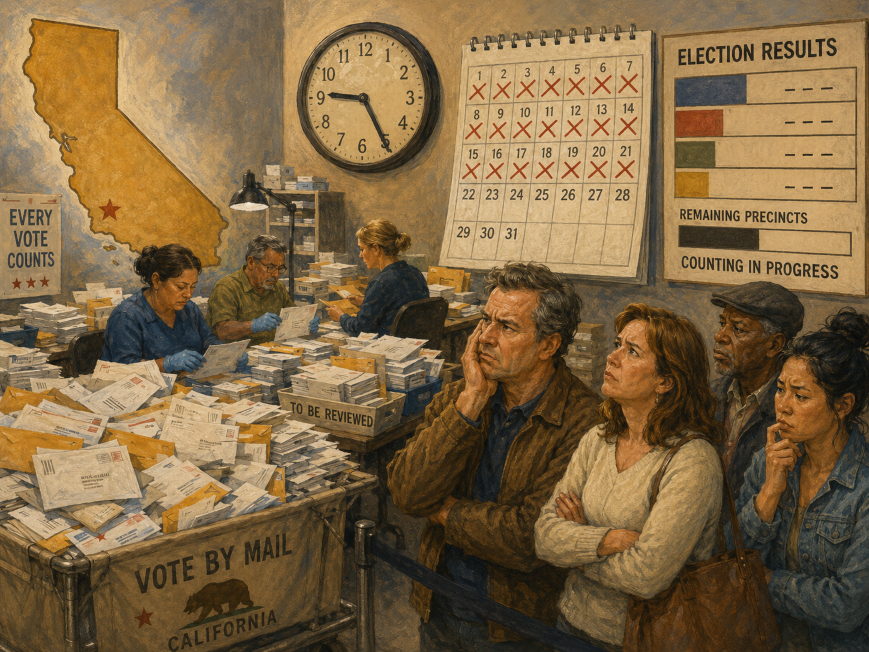
California takes longer to count votes than any other state in the country. That is not a conspiracy theory — it is a documented fact. In 2024, three days after Election Day, California had counted just 70 percent of its ballots. The national average at that point was over 95 percent. Florida, with a comparable mass mail-voting system and nearly as large an electorate, reported over 93 percent of its votes within 90 minutes of polls closing.
The reason is not incompetence, and it is not fraud. It is a specific policy choice: California allows mail ballots to be counted if they are postmarked by Election Day and received up to seven days later. That single rule keeps the ballot intake window open for a week after the election, meaning the total universe of valid ballots is unknown until well after Election Night. Everything else — the underfunded county offices, the signature verification backlogs, the jungle primary requiring near-complete tallies to confirm second-place finishers — is downstream of that one decision.
Florida solved the same challenge a different way. After the chaos of the 2000 recount, the state passed legislation allowing counties to begin processing mail ballots 22 days before Election Day, and set a hard receipt deadline so no ballots arrive after counting begins. The pipeline closes before the count starts. California has not made that choice, and officials have never been required to explain why — because the media has not asked.
Instead, the coverage has collapsed into two camps: Trump and his allies claiming fraud without evidence, and California officials and mainstream outlets dismissing all criticism as election denialism. Both framings are inadequate. Trump's fraud claims about this specific election remain entirely unsubstantiated. But the legitimate structural critique — that a seven-day open intake window creates conditions that are difficult to audit in real time, erode public confidence, and invite exactly the kind of disinformation California officials claim to be fighting — has been drowned out rather than examined.
The fraud picture in California deserves an honest accounting too. Documented cases exist. A Sonoma County man was convicted in 2024 after attempting to vote twice as an "experiment" — and notably, the system caught it before his second ballot was counted. A separate 2026 federal case charged a woman with paying people on Skid Row to register to vote, with the DOJ noting that California's universal mail ballot dispatch means some ballots could have gone to addresses where registrants no longer lived. No fraudulent ballots were confirmed as cast in that case. These are isolated incidents, not evidence of organized fraud. But they illustrate the specific mechanism by which the postmark rule and universal mail dispatch create downstream risk — and that is a different and more honest conversation than either "fraud is rampant" or "fraud is impossible."
California officials defending the current system routinely conflate two separate arguments: that the count is accurate, and that the count could not be faster without sacrificing accuracy. Florida disproves the second claim. You can have fast, accurate results without a post-Election Day intake window. The delay is a tradeoff — maximizing late ballot access over timely, auditable results — and state officials have consistently refused to name it as such. That refusal is the real story, and the media has largely let them get away with it.
Sources
- 1. Nate Silver / Silver Bulletin — ballot counting speed, California last place nationally
- 2. Ballotpedia — California vs. Florida pre-processing policy comparison
- 3. Bipartisan Policy Center — ballot pre-processing explainer
- 4. ABC News — Trump fraud claims, no evidence, U.S. Attorney declined to confirm
- 5. Democracy Docket — Trump DOJ investigation announcement
- 6. CBS Miami — Florida's 2001 Election Reform Act, pre-processing rules, receipt deadline
- 7. William Eschenbach conviction — Press Democrat (primary source)
About the Author
Don Keyhoetea
Don Keyhoetea writes for Rebuke Nation, an independent publication focused on media analysis, political framing, and source-based accountability.
Never miss a critique.
Subscribe to our RSS feed and get every new fact-check and media analysis delivered directly to your reader — no algorithm, no noise.